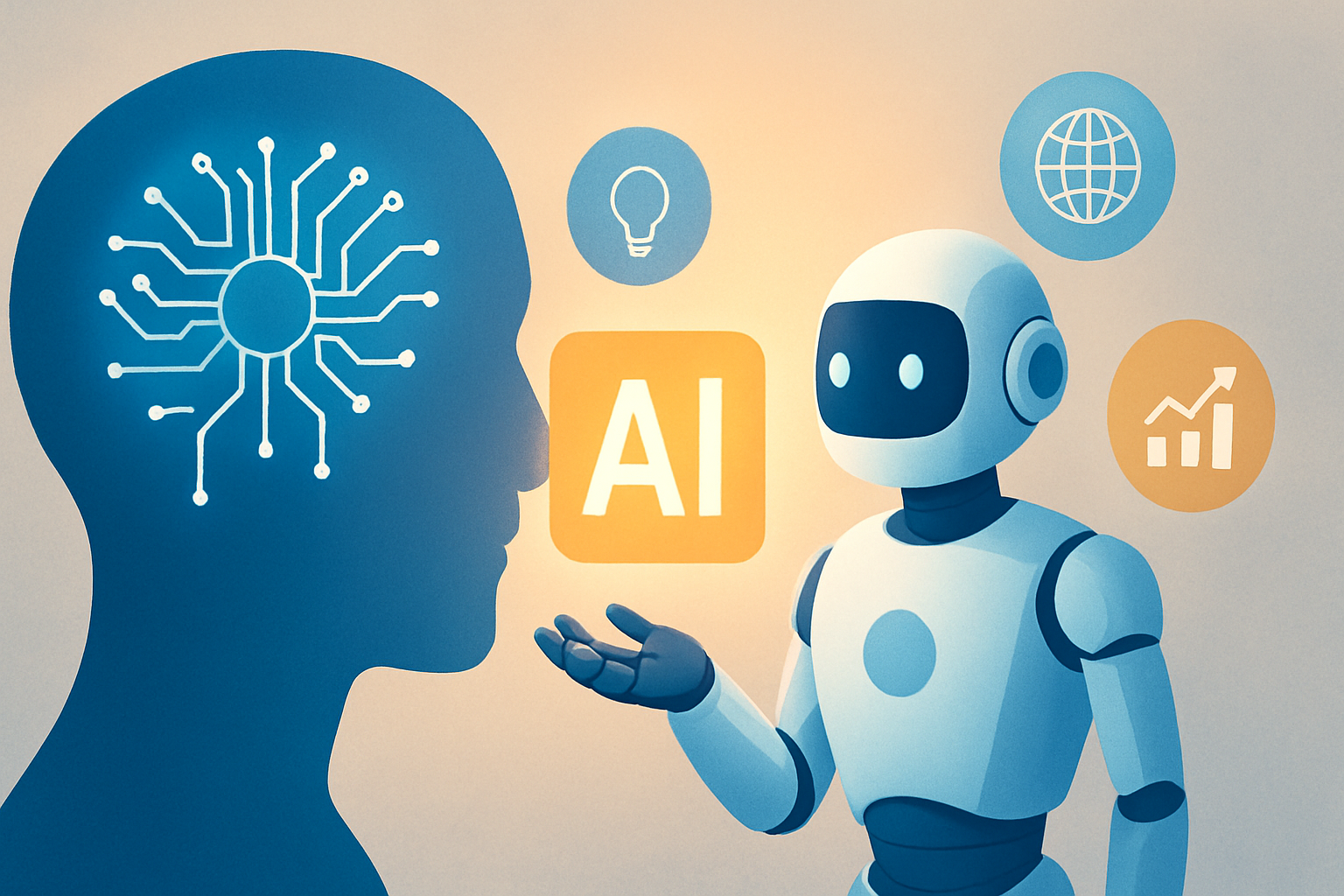
AI News: Innovations Changing the World
AI innovations are rapidly reshaping industries—improving decisions, automating routine work, and accelerating research. From healthcare to transportation, AI News highlights technologies that are moving from labs into everyday life.
Quick Overview
- Generative AI is changing how people write, design, and learn.
- AI copilots are transforming workplace productivity and workflows.
- Smarter models are expanding into healthcare and fintech.
- Transportation AI is improving routing, safety, and operations.
AI News and the Innovation Cycle
AI News today is less about single breakthroughs and more about steady progress. Each wave of innovation builds on earlier advances in data, compute, and model training. As a result, AI systems are becoming more capable, more reliable, and easier to integrate.
Meanwhile, the public conversation is also shifting. Early hype focused on “magic” outputs from chatbots. Now the focus moves toward measurable impact, including reduced costs, faster research, and better user experiences.
Importantly, adoption is not uniform. Some sectors move quickly because workflows are digital and data-rich. Other sectors require stronger safety controls and regulation. Therefore, innovation often arrives in stages.
What’s Driving Today’s AI Innovations
Several forces are converging to accelerate AI progress. First, foundation models are improving across text, images, audio, and video. Next, companies are learning how to deploy these models safely within real products.
Additionally, tool ecosystems are maturing. Many teams now connect AI to search, databases, and internal systems. This approach reduces hallucinations and improves usefulness in practical tasks.
Key technology themes
Across the AI landscape, these themes show up repeatedly:
- Multimodal AI: Models that understand and generate multiple input types.
- Smarter retrieval: Systems that ground outputs in trusted sources.
- Agentic workflows: Tools that can plan and execute multi-step tasks.
- Privacy and governance: Techniques for safer deployment in regulated settings.
- Edge AI: Running AI on devices to improve latency and privacy.
AI in the Real World: Where Change Is Happening Fast
AI innovations are already visible across consumer and enterprise markets. However, the most meaningful shifts often occur behind the scenes. They appear in decision support, automated operations, and faster development cycles.
1) Healthcare: From faster research to better triage
Healthcare has become a central theme in AI News. Clinicians and researchers use AI to assist with imaging analysis, patient risk scoring, and literature review. These tools can help teams process information that would be slow to handle manually.
At the same time, medical AI requires careful validation. Patient data is sensitive, and errors can be costly. Therefore, many deployments focus on narrow, high-impact use cases first.
2) Work and productivity: Copilots, automation, and AI assistants
In workplace settings, AI is changing how people produce information. Instead of starting from a blank page, users can draft, summarize, and refine content with guidance. This shift can reduce time spent on repetitive writing and editing.
Still, the biggest value often appears when AI connects to real workflows. For example, teams can use AI for meeting summaries, ticket classification, and knowledge base searches. As a result, the system becomes an operational helper, not only a chatbot.
If you want a deeper look at this space, see AI Tools Comparison for Teams for practical guidance on choosing platforms.
3) Finance and fintech: Risk modeling and fraud detection
Fintech firms leverage AI to detect fraud, predict churn, and optimize credit decisions. These systems can identify patterns that humans might miss in large datasets. Additionally, AI can support faster customer onboarding and more responsive support experiences.
Importantly, many teams also focus on explainability. Regulators and compliance teams need to understand why a decision was made. Consequently, modern AI projects often combine machine learning with auditing tools.
To explore more innovations in this sector, check AI Trends in Fintech You Can’t Ignore.
4) Transportation: Smarter routing and safer operations
Transportation is another major beneficiary of AI. Companies use predictive models for traffic forecasting, fleet maintenance, and route optimization. In logistics, these improvements can reduce fuel use and delivery delays.
Meanwhile, safety applications can assist in monitoring. They may flag risky driving conditions or anomalies in infrastructure sensors. Even so, deployments must balance performance with strict operational requirements.
In many cities, AI is also becoming part of traffic management systems. Therefore, the impact extends beyond logistics to everyday mobility.
If you are tracking broader AI developments across moving systems, consider AI in Transportation: What’s Next?.
How AI Innovations Work Under the Hood
Although AI News articles often mention “models,” the real story is the pipeline. Successful products combine training, data access, and deployment safeguards. As a result, the system performs well in real environments.
How It Works / Steps
- Collect and prepare data: Teams organize text, images, transactions, or sensor logs.
- Train or fine-tune models: Models learn patterns from data using specialized algorithms.
- Add retrieval and tools: Systems pull from trusted sources and connect to software.
- Evaluate with tests: Teams measure accuracy, safety, and edge-case performance.
- Deploy with monitoring: The system tracks drift, errors, and user feedback.
- Improve over time: Teams retrain and refine based on observed outcomes.
Why Generative AI Is So Visible
Generative AI stands out because it produces human-like outputs quickly. It can draft emails, create marketing copy, summarize documents, and generate design concepts. Consequently, many users experience AI improvements immediately.
However, the technology is broader than writing. Many organizations use generative models for code assistance, customer support drafts, and interactive learning tools. Therefore, its influence extends beyond “content creation.”
Still, quality depends on guardrails. Without constraints, models can produce plausible but incorrect information. For that reason, companies increasingly use retrieval grounding and confidence checks.
AI-driven content workflows are evolving
Marketing teams, in particular, adopt AI to increase throughput. They might generate first drafts, variants, and localized versions. Yet effective teams also review outputs and keep brand voice consistent.
For those looking to maximize productivity, consider Best AI Tools for Writing High-Converting Content. The goal is not more content, but better-performing content.
Examples of AI Innovations Changing the World
Below are practical examples showing how AI innovations can affect real outcomes. These scenarios are representative of how teams deploy AI across domains.
Healthcare operations
- Clinicians get summarized notes from long visit transcripts.
- AI helps prioritize patients based on risk indicators.
- Researchers find relevant studies faster through semantic search.
Customer support and knowledge bases
- AI drafts responses based on company documentation.
- Agents receive suggested next steps after a customer message.
- Teams auto-tag tickets to speed up routing and resolution.
Finance and banking
- Fraud systems flag suspicious patterns in real time.
- Risk models support credit decisions with better calibration.
- Automated reports reduce manual reconciliation effort.
Logistics and mobility
- Routing models recommend delivery paths with fewer delays.
- Maintenance tools forecast parts failures earlier.
- Traffic tools help estimate congestion and improve timing.
Challenges and Responsible Deployment
AI innovations bring benefits, but they also raise risks. One major issue is biased data, which can lead to unfair outputs. Another issue is security, since AI systems can be targeted with prompt injection or data exfiltration attempts.
To address these concerns, organizations adopt governance practices. They implement access controls, audit logs, and data handling policies. Additionally, teams create evaluation suites that test safety and accuracy.
Common pitfalls to watch
- Overreliance: Teams use AI outputs without verification.
- Weak grounding: Models answer without trusted sources.
- Poor monitoring: Errors go unnoticed after launch.
- Unclear ownership: Teams fail to assign accountability for decisions.
FAQs
What does “AI News” usually cover?
AI News typically covers new model capabilities, product launches, enterprise deployments, and policy updates. It may also include research findings with practical implications.
How can businesses benefit from AI innovations without overspending?
Start with narrow, high-value workflows. Then measure results with clear metrics like cycle time, error rates, or customer satisfaction.
Are generative AI tools always accurate?
No. Generative models can produce confident mistakes. That is why retrieval grounding, human review, and safety testing matter.
What is the biggest difference between AI prototypes and production systems?
Production systems include monitoring, governance, and evaluation. They also connect AI to reliable data and business logic.
Key Takeaways
- AI innovations are progressing from demos into operational tools.
- Multimodal and agentic systems expand what AI can do.
- Healthcare, fintech, and transportation show fast, measurable value.
- Responsible deployment is essential for accuracy and safety.
Conclusion
AI News is not just reporting new models. It is tracking real-world change across multiple industries. From improved healthcare workflows to smarter fintech decisions, AI is becoming a practical tool for organizations.
As these innovations mature, the winners will likely be teams that combine technology with strong governance. They will also build systems that integrate with existing processes. That balance turns AI from a novelty into sustained value.
The next chapter will focus on reliability, transparency, and broader adoption. Meanwhile, the pace of innovation suggests that AI’s impact will keep expanding.