How AI Is Transforming Hiring Processes
AI is reshaping hiring through automated screening, structured interviews, and data-driven decisions—while raising new challenges around fairness, transparency, and bias.
Quick Overview
- AI speeds up resume screening and reduces manual workloads.
- Structured assessments improve consistency across candidates.
- Bias risks require monitoring, audits, and human oversight.
- Successful adoption pairs AI with clear policies and measurable goals.
Why Hiring Is Changing Now
Hiring has always been a high-stakes process. However, today’s labor market is faster, more global, and more competitive. At the same time, recruiting teams face growing pressure to hire quickly and improve candidate experience. As a result, many companies are turning to artificial intelligence.
AI tools can help organizations screen applicants, interpret assessments, and support recruiters with decision-ready summaries. Moreover, they can reduce repetitive tasks that slow down hiring cycles. Yet these benefits come with responsibilities. Therefore, leaders must understand both the opportunities and the risks.
In this article, we explore how AI is transforming hiring processes across the recruitment lifecycle. We also cover practical steps, real-world use cases, and key questions to ask before adoption.
AI’s Role Across the Hiring Lifecycle
AI rarely replaces hiring teams. Instead, it acts like a force multiplier for sourcing, screening, interviewing, and onboarding. Consequently, the overall process becomes more consistent and measurable.
1) Sourcing and Candidate Discovery
AI can analyze talent databases and public profiles to identify candidates with relevant skills. Then it can help recruiters build targeted pipelines based on role requirements. Traditional sourcing often relies on keyword matching, which can miss strong candidates.
By contrast, modern AI systems can infer skill similarity from experience. For example, a recruiter may search for “customer success manager.” An AI model could also surface people who have “client outcomes” or “retention strategy” experience.
2) Resume Screening and Work History Analysis
Resume screening is one of the most time-consuming tasks in hiring. AI can parse resumes, extract structured data, and rank candidates for human review. Additionally, it can match applicants to job requirements more accurately than simple filters.
However, screening models must be carefully designed. Otherwise, they can reproduce historical biases from past hiring decisions. Therefore, organizations should validate results with fairness metrics and continuous testing.
3) Skills Assessments and Structured Interviews
Many companies now use AI-assisted assessments. These tools may evaluate coding challenges, writing samples, or task-based evaluations. In interview settings, AI can support structured questioning by aligning prompts to competencies.
Additionally, AI can generate interview guides and scoring rubrics. This approach improves consistency across interviewers. It also reduces the risk of subjective evaluations driving final decisions.
4) Candidate Communication and Scheduling
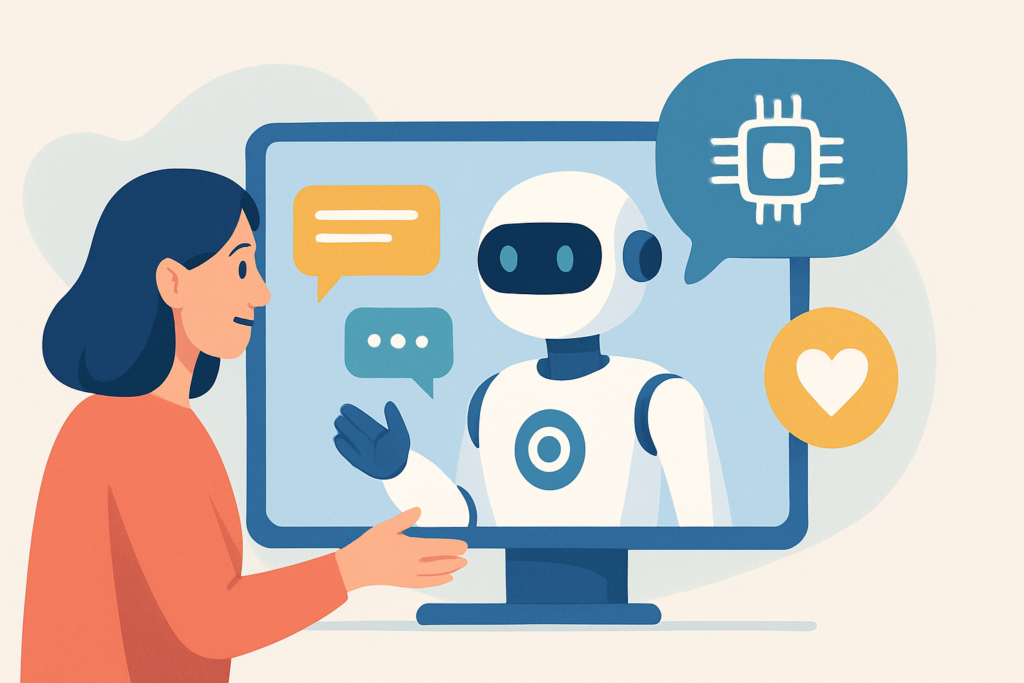
AI chat assistants can handle candidate inquiries at scale. For example, they can answer questions about interview logistics, role expectations, and submission requirements. Furthermore, they can schedule interviews by coordinating calendars and confirming times.
This reduces recruiter workload and helps candidates stay engaged. As a result, the hiring funnel becomes smoother, and drop-off rates may decline.
5) Decision Support and Pipeline Analytics
Recruiters need clarity on what is working. AI can analyze funnel metrics like time-to-hire, offer acceptance rates, and candidate drop-off points. Then it can surface patterns that improve recruiting strategy.
For example, AI might reveal that a specific interview panel reduces candidate acceptance. Alternatively, it could show that certain sourcing channels produce higher-quality hires. Consequently, leadership gains actionable insight.
Benefits: What AI Improves in Hiring
When deployed responsibly, AI can deliver meaningful improvements. These gains are often visible in both operational performance and candidate experience.
- Faster screening: Automating extraction and ranking cuts down early-stage delays.
- Better matching: Candidate-job fit becomes more nuanced than keyword searches.
- More consistent evaluations: Structured rubrics support repeatable scoring.
- Smarter outreach: Personalized messages can improve response rates.
- Data-driven decisions: Analytics highlight which strategies work best.
Just as importantly, AI can help recruiting teams focus on human judgment. Hiring decisions still require context, empathy, and business understanding. Therefore, the strongest implementations keep humans in control.
Risks and Bias: The Hard Part of Responsible AI Hiring
AI hiring systems can introduce risks if they are trained on biased data. For instance, if a company’s historical hiring favored certain groups, the model may learn those patterns. Over time, the system may replicate unfair outcomes.
Another issue involves transparency. Candidates often want to know how decisions are made. Yet some AI systems operate like black boxes. Without clear explanations, trust erodes quickly.
Privacy is also critical. Recruiters may process sensitive personal information. Therefore, organizations must ensure compliance with relevant regulations and internal policies.
Common risks to monitor
- Biased ranking: Models may disadvantage candidates with nontraditional backgrounds.
- Proxy variables: Factors like school name can reflect protected characteristics.
- Over-automation: Removing human review increases error and unfairness.
- Data drift: Performance can degrade as labor markets and resumes change.
- Opaque scoring: Candidates may not receive meaningful feedback.
To address these concerns, companies should build governance frameworks. They should also test for disparate impact and keep audit logs. As AI systems evolve, ongoing monitoring becomes non-negotiable.
How It Works / Steps
- Define hiring goals and success metrics. Start with target outcomes like time-to-hire, quality-of-hire, and candidate satisfaction.
- Map the workflow where AI will assist. Decide which steps are candidates for automation and which require human judgment.
- Prepare data and job requirements. Use structured job descriptions and standardized competencies to reduce ambiguity.
- Select or build AI models carefully. Prefer systems with documentation, fairness testing, and configurable thresholds.
- Validate performance and fairness. Run offline tests and pilot programs with representative candidate data.
- Set human-in-the-loop controls. Ensure recruiters review flagged decisions and can override model outputs.
- Monitor continuously in production. Track error rates, drift, and candidate feedback to keep results reliable.
- Improve with feedback loops. Use hiring outcomes to refine rubrics, prompts, and evaluation criteria.
Examples of AI Hiring in Action
AI adoption varies by company size and hiring volume. Still, the underlying patterns are consistent across industries. Here are common examples teams implement.
- Recruiting for high-volume roles: AI ranks applications, while recruiters focus on top candidates.
- Internal mobility programs: AI suggests internal candidates based on skills and career trajectories.
- Assessment-based hiring: AI supports evaluating work samples using defined scoring rubrics.
- Interview support: Tools generate role-specific questions and summaries for interviewers.
- Candidate experience automation: Chatbots answer FAQs and reduce response latency.
In each case, the best results come from clear evaluation standards. Moreover, organizations should keep documentation for decision rationale. That practice improves accountability and candidate trust.
Best Practices for Teams Implementing AI Hiring
Adopting AI in hiring is not just a technology purchase. It is a process change that requires alignment across legal, HR, engineering, and leadership. Therefore, companies should adopt practices that strengthen reliability and fairness.
Practical guidelines
- Use structured job requirements: Define competencies, skills, and experience signals explicitly.
- Establish audit and evaluation processes: Track model behavior and outcomes over time.
- Collect feedback from interviewers: Ensure rubrics match real-world performance.
- Provide candidate transparency: Explain how AI may be used in screening steps.
- Limit automation where judgment matters: Keep final decisions with trained humans.
Additionally, it helps to run A/B tests on candidate messaging and scheduling flows. That can improve conversion rates without changing selection criteria.
If you’re also exploring AI adoption across business functions, you may find this useful: How to Use AI for Risk Management.
AI Hiring and the Broader Business Trend
Hiring sits at the intersection of people, systems, and growth. As companies scale, they need repeatable processes that remain human-centered. AI supports that goal by standardizing parts of recruitment and surfacing insights from large datasets.
Meanwhile, organizations are also adopting AI across customer support, project planning, and analytics. Those trends share a similar pattern: automate routine tasks, then measure outcomes. If you want an example of that mindset in operations, explore Best AI Tools for Customer Support.
Finally, hiring is becoming a strategic advantage. Teams that improve speed and quality can compete for talent more effectively.
FAQs
Can AI replace recruiters?
Not in most practical cases. AI can assist with screening, scheduling, and summaries. However, recruiters provide context, negotiation, and relationship-building.
Does AI always reduce bias in hiring?
No. AI can reduce bias only if it is designed and monitored responsibly. If models learn from biased historical decisions, they can worsen disparities.
How can companies ensure fairness with AI hiring tools?
They should conduct fairness testing, track disparate impact, and allow human overrides. Continuous monitoring is essential, especially after model updates.
What data is typically used in AI hiring?
Common inputs include resumes, work histories, assessment results, and job descriptions. Some systems also use interaction data like scheduling and communication patterns.
Is it safe to use AI for resume screening?
It can be safe when used with governance, transparency, and validation. Organizations should pilot systems, document decisions, and provide candidates with clear guidance.
Key Takeaways
- AI improves speed, consistency, and analytics across recruiting workflows.
- Human oversight remains essential for accuracy and fairness.
- Bias, transparency, and privacy risks must be actively managed.
- The best deployments start with measurable goals and continuous monitoring.
Conclusion
AI is transforming hiring processes by modernizing how candidates are sourced, screened, assessed, and engaged. Yet the biggest lesson is simple: technology changes the workflow, but governance determines the outcome. Companies that treat AI as an assistive tool, not a decision substitute, are more likely to build fair and effective hiring systems.
As adoption grows, recruiting leaders should focus on structured criteria, ongoing evaluation, and candidate trust. In the long run, those choices will shape not only hiring speed. They will also shape the quality of teams and the integrity of the process.
For more perspectives on how AI reshapes business outcomes, you can explore AI Tools Comparison for Beginners and build a clearer view of what fits your organization.