How AI Is Disrupting Creative Industries
AI is disrupting creative industries by accelerating content creation, changing how teams work, and redefining what “original” means for creators and brands.
Quick Overview
- AI tools can generate images, text, video, and audio faster than traditional workflows.
- Creative roles shift toward direction, editing, and quality control rather than pure production.
- New IP, licensing, and consent questions are moving from theory to boardroom policy.
- Brands gain personalization, while audiences face deeper “synthetic” content saturation.
AI in Creative Industries: The Disruption You Can Feel
AI is no longer a futuristic curiosity. It is actively changing how creative work gets made and sold. Across design studios, marketing teams, film pipelines, and gaming companies, AI systems are now part of everyday production. That shift is disruptive because it affects both speed and economics.
In many settings, the first change is practical. Teams produce drafts in minutes, not days. Then they iterate quickly, using AI-assisted tools for variations and refinements. As a result, creative cycles compress dramatically, and traditional planning assumptions break down.
However, disruption is not only about efficiency. AI changes the creative identity of industries that historically relied on human skill and time investment. It also raises new debates about ownership, authorship, and whether audiences will accept synthetic output. Therefore, the impact spans technology, business strategy, and culture.
Why This Shift Happens Now
The recent wave of disruption is powered by several factors working together. First, generative models have improved substantially in text understanding and multimodal output. Second, accessibility has increased through APIs and user-friendly platforms. Third, costs have dropped enough to bring experimentation inside mainstream businesses.
Meanwhile, data has become more usable. Many organizations now have archives, brand guidelines, and content libraries ready for training or prompting. Even when systems are not trained on proprietary data, they can still mirror style patterns via instructions. Consequently, AI can behave like a “creative assistant” rather than a remote research project.
At the same time, attention markets are getting crowded. Brands need more content to remain visible. Therefore, AI becomes an attractive lever for scaling creative output without scaling headcount at the same rate.
Key Ways AI Is Disrupting Creative Workflows
To understand disruption, it helps to look at what creative teams actually do. Most workflows include research, ideation, production, editing, and distribution. AI is now altering multiple stages, often at once. As a result, the whole pipeline starts to behave differently.
1) Ideation Becomes Instant and Infinite
Historically, ideation required long brainstorming sessions and moodboards. Now, generative AI can propose concepts, headlines, taglines, and scripts quickly. It can also generate multiple visual directions based on a single prompt. This speed changes expectations for early-stage creative exploration.
Nevertheless, “instant” does not mean “better.” Teams still need curation and taste. AI outputs are often plausible but not always aligned with strategy. Therefore, humans increasingly act as directors and editors, not just idea generators.
2) Production Shifts Toward Templates and Variation
Instead of starting from scratch, many teams now build on repeatable structures. AI can produce variations of a style, a layout, or an animation. This approach resembles scalable marketing design more than one-off craftsmanship. Consequently, creative output can become more consistent across channels.
However, this shift can also create sameness. If teams overuse similar prompts and datasets, work can start to feel generic. Smart organizations counter this by enforcing creative briefs, brand rules, and human review standards.
3) Editing and Post-Production Accelerate
Editing is expensive in time and specialized skills. AI helps by automating tasks like background removal, transcription, and rough cut assembly. It can also suggest color adjustments or generate alternate takes. Thus, post-production budgets can stretch further.
As editing becomes faster, production teams may experiment more. That can lead to higher creative risk-taking. Yet it also pressures teams to publish sooner, increasing the likelihood of quality drift.
4) Distribution Gets More Personal
AI is also changing distribution through targeting and personalization. Content can adapt based on viewer preferences, geography, and device. This means creative work is no longer “one size fits all.” Instead, it becomes modular and responsive.
Interestingly, this blurs the line between creative production and performance marketing. The creative strategy becomes tightly coupled with data feedback loops. If you want a deeper view of data-driven trends, see AI trends in predictive analytics.
Economic Impact: Who Benefits and Who Loses?
Creative industries are competitive by nature. AI disruption changes pricing power and bargaining positions. In some cases, it reduces production costs and speeds delivery. In other cases, it threatens livelihoods by lowering demand for certain tasks.
For studios and agencies, AI can create new leverage. They can deliver more versions, iterate faster, and meet tighter turnaround deadlines. That can attract clients who previously delayed projects due to cost constraints.
For individual creators, outcomes are mixed. Some creators use AI to produce faster portfolios or explore new styles. Others worry about being replaced by synthetic output or undercut by cheaper AI-generated alternatives. Therefore, policy and licensing will likely shape the long-term balance.
New Business Models Are Emerging
Because AI can generate content quickly, business models are evolving. Instead of selling one final asset, companies may sell “creative systems.” Those systems include brand rules, prompt libraries, and content pipelines that continuously generate outputs.
Additionally, usage-based pricing is gaining popularity. Clients pay for tokenized generation, editing time, or usage volume. Over time, creative work may resemble SaaS operations more than traditional studio production.
However, the most durable advantage will be quality and differentiation. Markets can be flooded with generic output. Brands that invest in distinct voice, rigorous review, and human oversight stand out.
Authorship, Copyright, and Ethical Risks
No discussion of AI disruption is complete without addressing ethics and intellectual property. AI systems can generate content that resembles existing styles. They may also reproduce recognizable elements when prompts are specific. This creates uncertainty for creators and legal teams alike.
Consent is another pressing issue. Many datasets used to train models were not designed with explicit permission from every artist. Therefore, disputes can arise about whether outputs are transformative or derivative.
In response, the industry is moving toward new standards. Some platforms offer licensing frameworks. Others allow creators to opt out or manage rights. Even so, the environment remains unsettled, and companies must plan for compliance.
What Brands Are Doing to Reduce Risk
Many organizations now treat AI output like a managed asset. They implement review workflows, keep audit trails, and document sources where possible. This is especially important for regulated industries.
Common risk-reduction steps include:
- Requiring human approval before publication.
- Using model providers with clear licensing terms.
- Maintaining style guides and brand guardrails.
- Tracking prompts and revisions for auditability.
- Testing output for factual errors and bias.
The Human Role: From Creator to Creative Director
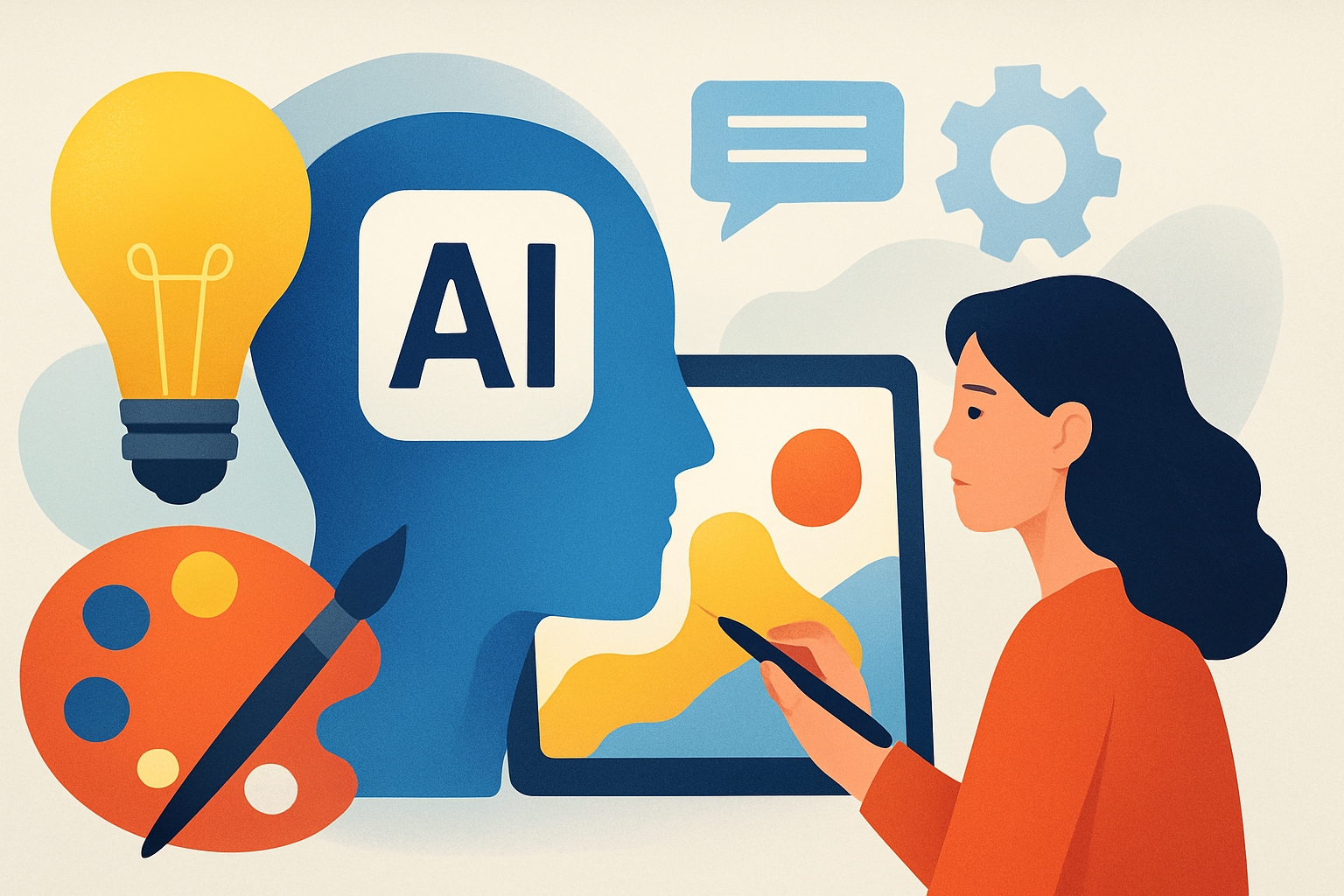
One of the biggest misconceptions is that AI eliminates creativity. In reality, it changes who does what. Humans still decide what matters. They also bring context, cultural understanding, and emotional nuance.
In many teams, the role shift looks like this. AI handles first drafts and rapid variations. Humans provide direction, set constraints, and evaluate coherence with the brand. Then they refine the final output to ensure it is authentic and strategically aligned.
As a result, creative leadership becomes more technical. Directors must understand model capabilities and failure modes. They also must manage workflows that combine human taste with machine speed.
Real-World Examples Across Creative Sectors
AI disruption is visible in multiple industries. The exact tools differ, but the pattern remains. Faster iteration leads to more volume, and more volume changes competition.
Advertising and Marketing
Ad teams use AI to draft concepts, create variations, and localize campaigns. Instead of designing one campaign globally, they generate region-specific versions. This can improve relevance while reducing production time.
Nevertheless, brands must avoid “brand drift.” Without strong guidance, AI can produce creative that looks on-brand but sounds off-message.
Design and Product Visualization
Designers use AI for concept explorations and rapid visualization. For product teams, that can shorten the distance from idea to prototype communication. It also supports A/B testing for landing pages and visuals.
If you’re interested in optimization methods, check out top AI tools for website optimization. Those tools often complement creative generation with performance insights.
Film, Animation, and Gaming
Studios use AI to assist with storyboards, script drafts, and asset generation. In gaming, it can help create texture variations and environmental details. Still, high-stakes productions require careful human control for consistency and quality.
Here, AI can accelerate pre-production. Yet it usually does not replace full production talent. Instead, it compresses early-stage iteration and supports rapid prototyping.
Music and Audio Production
AI can generate melodies, propose chord progressions, and assist with mixing. It can also help with voice-related tasks and sound design. However, the audio industry faces unique licensing and consent challenges.
Therefore, the key question becomes whether AI outputs can coexist with creator rights and ethical standards. This is likely to shape adoption in the coming years.
How It Works / Steps
- Define the creative brief. Teams set goals, audience, tone, and constraints.
- Select the AI workflow. Tools may focus on text, image, video, or editing assistance.
- Generate multiple drafts. AI produces variations for faster exploration and selection.
- Apply human direction. Creators refine concepts, enforce brand rules, and correct issues.
- Edit, verify, and finalize. Teams check for factual accuracy, visual consistency, and compliance.
- Distribute with performance feedback. Data informs further iterations and personalization.
Examples: Where AI Fits in a Modern Creative Team
Consider a typical marketing campaign. A team might use AI to draft headlines and visuals, then human designers refine composition and typography. After that, editors test variations across channels.
Another example involves product storytelling. A startup can generate product descriptions, benefit statements, and example use cases quickly. Then it adds real customer feedback and technical specificity, making the final content more trustworthy.
Finally, media organizations can speed research summaries. AI can help extract themes and propose outline structures. However, journalists still verify facts and cite primary sources.
AI Content Saturation: Opportunity and Overload
AI can boost creative output. It can also flood the market with content. That creates a new challenge: attention selection. Audiences may become harder to impress, and marketing messages may blend together.
To stand out, organizations must build differentiation. That can include unique brand voice, original data, and community-driven creativity. AI can help generate drafts, but it cannot create true loyalty.
Consequently, the competitive frontier shifts from “who can make something” to “who can make something memorable.” Memorable work usually needs lived experience and human judgment.
FAQs
Will AI replace creatives in the creative industries?
AI will replace some tasks, not entire creative careers. Many roles shift toward direction, editing, and strategy. Human taste remains crucial for differentiation and quality.
Is AI-generated content considered original?
Originality depends on how content is created and whether it meaningfully transforms input. Legal frameworks are evolving, so organizations should adopt clear review and licensing processes.
How do companies reduce legal and ethical risks?
They can use licensed models, require human approval, document sources where possible, and implement audit trails. Teams should also monitor output for bias and factual errors.
What skills will matter most for creators going forward?
Prompting is only a starting point. Strong communication, brand strategy, editing, and technical workflow knowledge become increasingly valuable.
Key Takeaways
- AI accelerates ideation, production, and editing across creative workflows.
- Creative jobs evolve toward direction, quality control, and strategic oversight.
- Intellectual property and consent issues remain central to adoption decisions.
- Brands must differentiate to avoid generic, AI-saturated content.
Conclusion
AI is disrupting creative industries in visible and measurable ways. It speeds up drafts, scales personalization, and compresses production timelines. Yet it also intensifies pressure around quality, authenticity, and rights management.
The most successful organizations will treat AI as a tool, not a replacement. They will combine human direction with machine efficiency. At the same time, they will invest in governance, licensing, and ethical review.
Ultimately, creativity is still a human advantage. AI changes the process, but it does not remove the need for vision. The future belongs to teams that can move quickly while staying unmistakably original.