Free AI Tools for Audio Editing: The Fastest Ways to Clean, Enhance, and Remix Sound
Free AI tools can clean noise, enhance vocals, and improve mix clarity without expensive plugins. This guide covers practical options and a workflow you can use today.
Quick Overview
- AI audio editing helps remove noise, boost speech clarity, and correct timing.
- Many tools offer free tiers that work in browsers or with simple downloads.
- A repeatable workflow prevents quality loss and speeds up production.
The Real Value of Free AI Tools for Audio Editing
Audio editing used to mean hours of manual cleanup. Now, AI can automate many tedious steps. That shift matters for creators, educators, and small teams.
With free AI tools, you can improve recordings without buying a full suite. You can also prototype faster before you commit to paid software. As a result, your workflow becomes more flexible.
Most importantly, AI helps you focus on the creative parts. It handles the mechanical parts, like noise reduction and voice enhancement. Then you make final adjustments with your ears.
What “AI Audio Editing” Actually Does
AI in audio editing usually relies on machine learning models. These models learn patterns in sound, speech, and noise. Consequently, they can separate components more intelligently than basic filters.
Common AI capabilities you’ll see
- Noise reduction: Removes steady background hiss and some room noise.
- Voice enhancement: Improves intelligibility for speech and podcasts.
- Echo and reverb reduction: Can reduce obvious spaces, especially in dry recordings.
- Music separation: Splits vocals, drums, bass, or accompaniment.
- Auto-leveling and normalization: Stabilizes loudness across a segment.
- Beat detection and timing cues: Helps with alignment for editing.
However, results depend on source quality. A noisy mic in a reflective room will still be challenging. Still, AI tools often make a clear improvement quickly.
Best Free AI Tools for Audio Editing (Practical Picks)
Below are categories of free tools and what they’re typically best at. Availability can change, so check each tool’s current pricing or free tier.
Also, consider whether you need a web app or local editing. Browser tools are faster to start. Local tools can offer more control and privacy.
1) Free AI tools for cleaning speech and podcasts
Speech-focused tools are usually optimized for clarity. They target consonants, reduce breath noise, and smooth harsh frequencies. As a result, they work well for interviews and video voiceovers.
Look for features like “voice enhancement,” “speech clarity,” and “noise suppress.” If a tool previews before export, even better.
2) Free AI noise reduction and audio denoising tools
Noise reduction tools generally use spectral processing and learned noise models. They can reduce hiss and hum. Yet they may also remove some desirable ambience.
Use them moderately. After applying noise reduction, always listen at lower volume. This helps you catch artifacts and unnatural textures.
3) Free AI for music separation and remix workflows
Music separation uses AI to split stems. That means vocals, drums, bass, and instruments can become editable parts. Therefore, you can create remixes or isolate sections for learning.
However, separation quality varies by genre and mix complexity. Dense tracks with multiple harmonies can be harder. Still, the free tier often provides enough output for quick experiments.
4) Free AI tools for loudness leveling and normalization
Loudness issues are common in user-generated content. Auto-normalization uses loudness standards to keep audio consistent. Consequently, your clips sound more professional.
For podcasts and video platforms, consistent loudness reduces listener fatigue. It also helps cuts sound smooth across scenes.
5) Free AI helpers for transcription-aligned edits
Some free tools connect audio to text. Then you can edit based on words, timestamps, or segments. This makes trimming mistakes much faster.
If you edit interviews, this can save significant time. You can also identify filler words by scanning transcripts.
If you also work with knowledge workflows, you may like AI Tools for Knowledge Management for organizing drafts and transcripts.
A Step-by-Step Workflow to Get Better Audio Faster
You don’t need complicated steps to get noticeable improvements. The key is to edit in the right order. That preserves quality and avoids double-processing artifacts.
How It Works / Steps
- Choose the right free tool for your goal. Decide between voice enhancement, noise reduction, or music separation.
- Start with a clean reference. Listen to the original and note specific problems, like hiss or muddiness.
- Apply denoising lightly first. Use the lowest effective strength and enable previews if available.
- Enhance speech or vocals. Boost clarity and presence without over-brightening.
- Normalize loudness. Aim for consistent volume across clips, especially for multi-segment videos.
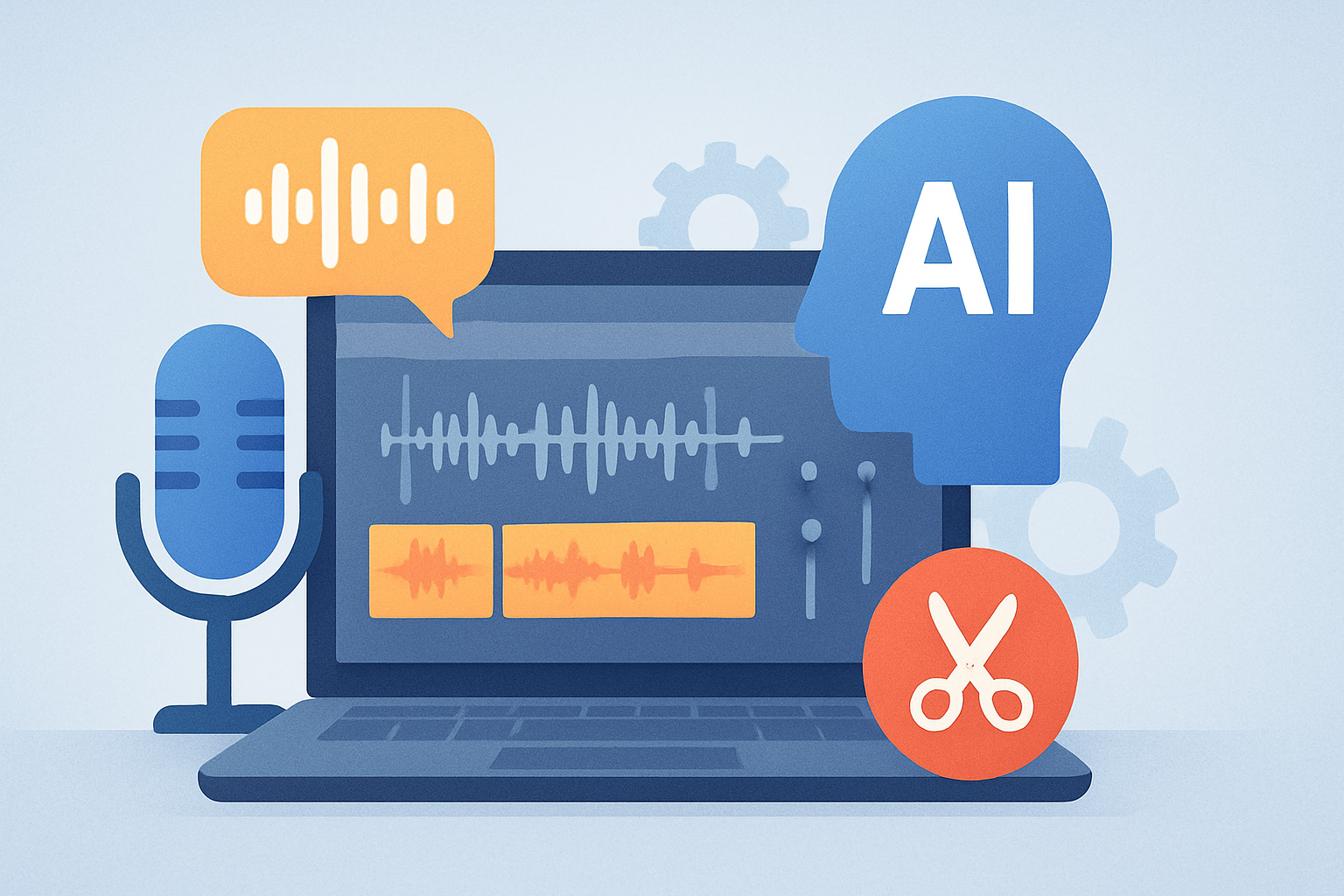
- Trim using transcripts or waveforms. Remove pauses and errors while keeping natural pacing.
- Export in a reliable format. Use a standard codec that matches your platform needs.
- Do a final human listening pass. Test on headphones and a phone speaker.
Editing Scenarios: Where Free AI Tools Shine
Different creators face different audio problems. Therefore, it helps to match your tool choice to your scenario. Below are concrete examples you can adapt to your own work.
Examples
Example 1: Cleaning a podcast interview
Recordings often include background fans, street noise, and inconsistent volume. Start by reducing steady noise. Then enhance voice clarity to improve consonants. Finally, normalize loudness across the conversation.
Example 2: Fixing a shaky voiceover for video
Voiceovers can sound thin or echoey. Use voice enhancement to add intelligibility. Next, apply reverb reduction if the tool supports it. After that, trim long silences so the narration feels deliberate.
Example 3: Preparing training audio for e-learning
E-learning content needs clarity more than style. Use denoising and speech-focused enhancement. Then ensure consistent loudness for each module. If you have transcripts, align key sections to improve searchability.
Example 4: Isolating vocals for a remix
AI stem separation can help you extract vocal lines. After separation, you can re-time vocals to a new beat. Then you apply gentle leveling so the vocals sit naturally in the mix.
Example 5: Creating accessible audiobooks
For accessibility, clarity is critical. Use noise reduction to remove distractions. Then apply normalization to keep listening comfortable. When possible, trim breaths and long pauses carefully to preserve pacing.
Additionally, if your work involves structured planning, you might enjoy How AI Is Changing Online Education for ideas on scalable learning workflows.
Common Pitfalls When Using Free AI Audio Editors
Free tools can be powerful, but they’re not perfect. Understanding limitations helps you avoid frustrating results. It also improves consistency across projects.
Avoid these frequent issues
- Over-aggressive noise reduction: Leads to robotic artifacts or “watery” audio.
- Too much vocal enhancement: Can create harsh sibilance and unnatural tone.
- Double processing: Running multiple denoise passes often degrades quality.
- Exporting the wrong format: Some platforms require specific codecs or sample rates.
- Ignoring monitoring: Always check on different speakers and in real playback conditions.
Because AI edits are probabilistic, always keep your original file. Store a “master” version and export edited copies from it. This protects your best sound as you experiment.
Privacy, Copyright, and Ethical Considerations
When uploading audio to free web tools, privacy matters. You should review the tool’s policies before processing sensitive recordings. Look for options like deletion timelines or local processing.
Copyright is another critical factor. If you upload commercial music for separation, confirm whether it’s allowed. Many creators use AI separation for personal projects. Still, distribution can create legal risk.
Finally, be transparent when AI changes speech. If your content is educational or journalistic, accuracy is paramount. AI editing can help clarity, but it shouldn’t mislead audiences.
FAQs
Are free AI tools for audio editing good enough for professional work?
They can be good enough for many projects, especially speech cleanup and quick music edits. For professional mastering, you may still need paid tools. However, free tiers often deliver impressive results when used carefully.
Will AI noise reduction remove all background noise?
Not always. It works best on steady noise like hum and hiss. If the noise overlaps speech frequencies, some artifacts may appear. In those cases, lighter settings usually produce better results.
Can I edit music with free AI tools without harming quality?
Yes, if you avoid repeated processing. Use one main AI pass and then do minor manual edits. Also, export in the highest quality format supported by your workflow.
Do AI audio tools require downloads?
Some do, and many run in browsers. Browser tools are convenient, while local tools can offer more control. If privacy is a concern, prefer local processing when available.
What audio format should I export?
It depends on your platform. For most workflows, WAV is safest for editing. For sharing, MP3 or AAC often works well. Check your publishing requirements before final export.
Key Takeaways
- Free AI tools can quickly improve clarity, reduce noise, and normalize volume.
- Choose the right tool for the specific problem: speech, noise, separation, or leveling.
- Use a careful order: denoise lightly, enhance voice, normalize, then trim.
- Always listen on multiple devices and keep originals to protect quality.
Conclusion
Free AI tools for audio editing make modern production accessible. They help you clean speech, stabilize loudness, and experiment with music separation. With a smart workflow, you can get professional-sounding results faster.
Start small, test your edits, and keep your expectations realistic. Then iterate until your audio matches your content goals. Over time, these tools can become part of your standard creative process.
If you want to connect audio work to broader tech learning and content strategy, explore Top AI Trends Every Marketer Should Know for ideas on how teams scale production responsibly.