AI Trends in Autonomous Vehicles: What’s Next for Self-Driving Systems
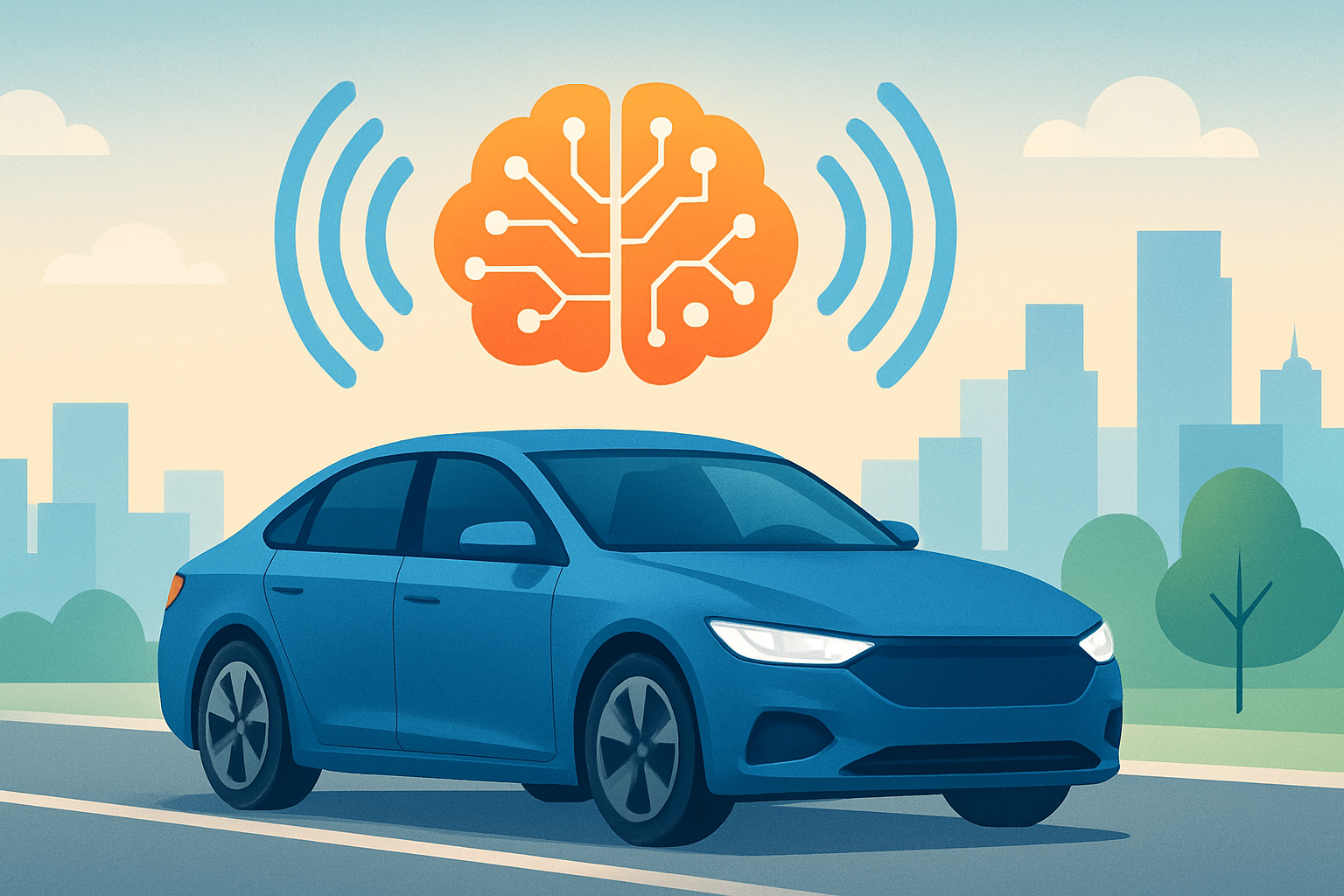
Autonomous vehicles are shifting toward multimodal AI, stronger safety layers, faster on-device inference, and simulation-driven testing. These AI trends will shape how fleets scale and how regulations evolve.
Quick Overview
- Multimodal perception is becoming standard, combining cameras, radar, lidar, and learned priors.
- Planning and driving policies are moving toward safety-first architectures with verifiable constraints.
- Simulation and synthetic data are accelerating training while reducing costly real-world miles.
- Edge AI and compact models improve latency, privacy, and reliability during deployment.
- Regulatory readiness and auditability are becoming core engineering requirements.
AI Trends in Autonomous Vehicles: The Biggest Shifts
AI in autonomous vehicles is no longer just about “recognizing objects.” Today’s systems must interpret complex scenes, predict motion, and choose safe actions under uncertainty. Consequently, the newest AI trends focus on robustness and safety, not only accuracy.
In parallel, the industry is learning from real deployments. As a result, engineering teams are redesigning pipelines from sensors to decision-making. They also prioritize compute efficiency, since vehicles operate under strict power and latency limits.
Furthermore, autonomy is becoming more modular. Instead of one monolithic neural network, many stacks use specialized models plus classical safety constraints. This blend helps teams scale across different environments and sensor configurations.
1) Multimodal Perception and Sensor Fusion
One of the most important AI trends in autonomous vehicles is multimodal perception. Cameras provide rich semantic detail, while radar offers reliable velocity estimates. Lidar adds 3D structure, which can stabilize depth and geometry understanding.
However, multimodal does not mean simply “using more sensors.” Instead, the key challenge is fusion: aligning sensors in space and time, then learning how to trust each modality. Therefore, modern systems use architectures that combine learned features with uncertainty estimates.
Additionally, researchers are exploring sensor dropout training. During training, models randomly hide one sensor source. This strategy helps the system remain stable when hardware degrades in the field.
What this changes for real driving
In practical terms, improved fusion can reduce brittle behavior. For instance, it may help navigation in rain, glare, or low-contrast conditions. It can also improve vehicle motion predictions when objects partially occlude each other.
2) End-to-End Learning Meets Safety-Critical Design
End-to-end driving models are an ongoing trend in autonomy. These models aim to map sensor inputs directly to driving actions. Yet safety is still the deciding factor for real-world use.
Therefore, many stacks now use a hybrid approach. They combine learning-based perception and prediction with rule-based or constraint-based planning. This structure creates a “safety envelope” around the driving policy.
In the same spirit, teams are adopting monitoring systems. These monitors detect unusual behavior and trigger fallback modes. As a result, the AI can remain conservative when confidence is low.
Safety layers gaining traction
- Trajectory constraints: Planning must respect curvature, acceleration, and collision risk bounds.
- Uncertainty-aware decisioning: The system adjusts behavior based on confidence levels.
- Independent verification: Separate models or checks validate proposals before execution.
- Fail-safe behaviors: Automated braking and pull-over routines handle edge cases.
3) Simulation-First Development and Synthetic Data
Autonomous vehicles are data hungry. To learn driving policies, systems require diverse examples of rare events. However, collecting those events on public roads is expensive and slow.
As a result, simulation is becoming the center of development. Teams generate scenarios with controllable variables, such as weather, lighting, and traffic density. They also simulate sensor noise and miscalibration effects.
Crucially, modern simulation is not just about rendering. It also models physics and sensor characteristics. Therefore, synthetic data can better match reality when training perception and planning modules.
Why this trend matters now
Simulation accelerates experimentation with fewer real-world risks. Moreover, it enables systematic testing for safety coverage. In turn, this helps teams demonstrate improvements to regulators and stakeholders.
4) Edge AI: Lower Latency, Better Reliability
Autonomous driving demands low latency. If perception and planning are too slow, the vehicle’s decisions arrive late. Hence, edge AI is one of the most practical AI trends in autonomous vehicles.
Edge AI focuses on running models inside the vehicle hardware stack. That means using optimized runtimes, quantization, and carefully designed neural networks. Consequently, vehicles can respond quickly without relying on external connectivity.
Privacy also improves. Data can remain on-device instead of streaming continuously. Meanwhile, offline operation becomes more reliable during network outages.
Common edge optimization techniques
- Model compression: Quantization and pruning reduce compute costs.
- Specialized accelerators: Hardware targets improve inference speed.
- Scheduling strategies: Pipelines prioritize critical tasks first.
- Selective inference: Some models run only when needed.
5) Prediction That Understands Intent, Not Just Motion
Another major trend is more sophisticated motion forecasting. Traditional approaches tracked where objects might go. Modern systems go further and estimate intent, such as lane changes or pedestrian crossing behavior.
To do this, AI models incorporate context. They use map information, traffic rules, and scene semantics. Additionally, they may model multi-agent interactions, where each participant influences others.
Therefore, the best systems reduce “surprises.” They react to behavior, not only coordinates. That makes driving smoother and safer in dense urban environments.
6) Roadmaps for Regulation, Auditability, and Trust
As autonomy expands, regulation becomes a design constraint. Regulators increasingly ask for traceability and evidence. That means teams must explain how systems behave and how they are tested.
Accordingly, auditability is rising as a core AI trend. Engineers want logs that show model inputs, outputs, and decision reasons. They also want reproducible test results.
In practice, auditability pushes teams toward structured pipelines. It also encourages standardized evaluation metrics across fleets and manufacturers.
If you want background on responsible AI strategies, explore AI trends in blockchain technology, which often intersects with audit trails and verification.
7) Smarter Data Flywheels: From Fleet Logs to Model Updates
Autonomous vehicles increasingly learn from their own experiences. Fleet deployments generate driving logs, which are then labeled and curated for training. Over time, that process becomes a data flywheel.
Yet quality matters more than quantity. Teams focus on selecting rare but critical scenarios. They also implement better labeling workflows and automatic event clustering.
As a result, model updates become more targeted. This shortens iteration cycles and helps fleets improve without retraining from scratch every time.
How It Works / Steps
- Perception: Sensors capture the environment and AI extracts objects, lanes, and free space.
- Prediction: The system forecasts trajectories and intent for surrounding agents.
- Planning: A policy selects safe maneuvers under constraints and uncertainty.
- Safety validation: Additional checks verify candidate trajectories before execution.
- Control: The vehicle translates planned motion into steering, throttle, and braking commands.
- Data logging: Edge systems store relevant signals for later analysis and improvement.
- Training and update: Teams use simulation and fleet data to retrain and validate models.
Examples of AI Trends in Autonomous Vehicles
These trends show up in multiple vehicle layers. Below are realistic examples you might see in modern autonomy roadmaps.
Example 1: Multimodal fusion for tough weather
In heavy rain, camera performance can degrade. Meanwhile, radar velocity can remain stable. Therefore, a fusion module can keep track of motion and reduce sudden perception failures.
Example 2: Constraint-based planning with learned intent
A planning model might predict a pedestrian’s intent to cross. However, it must still respect collision risk thresholds. Consequently, learned intent guides behavior, while safety constraints enforce conservative actions.
Example 3: Simulation-driven safety coverage
Teams can generate thousands of “near-miss” scenarios in simulation. They can then test which trajectories violate safety boundaries. As a result, developers can prioritize fixes before real-world testing.
Example 4: Edge inference for rapid obstacle avoidance
Compact models can run faster on vehicle hardware. That lowers reaction time during sudden merges. In turn, this improves smoothness and reduces unsafe braking.
If you’re also curious about broader AI deployment patterns, see top AI tools for developers for tooling ideas that complement autonomy workflows.
FAQs
Are autonomous vehicles moving toward fully end-to-end driving?
They are moving toward end-to-end components, but not necessarily fully end-to-end systems. Many stacks still use safety layers and verification. This hybrid approach balances performance with reliability.
Why is simulation so important for autonomous vehicles?
Simulation helps teams test rare scenarios safely and repeatedly. It also speeds experimentation by controlling variables. When synthetic data matches sensor physics, training improves and costs drop.
What role does edge AI play in autonomy?
Edge AI enables real-time inference inside the vehicle. It reduces latency and avoids dependence on connectivity. It also supports offline operation and improves privacy.
How do teams measure progress in AI driving systems?
They track both accuracy and safety metrics. Common measures include object detection performance, prediction error, and collision risk rates. Equally important, teams evaluate scenario coverage and improvement under edge cases.
Key Takeaways
- Multimodal perception is becoming the foundation for robust autonomy.
- Safety-first design is reshaping how AI plans and executes driving actions.
- Simulation and synthetic data reduce risk and accelerate model improvement.
- Edge AI is essential for low-latency decision-making and dependable operation.
- Auditability and regulation readiness are now engineering priorities.
Conclusion
AI trends in autonomous vehicles are converging on a clear goal: dependable driving under real uncertainty. Multimodal perception improves scene understanding, while safety layers keep decisions constrained. Meanwhile, simulation-driven development and edge AI help teams iterate faster and respond quickly.
Just as importantly, the industry is learning how to earn trust. Auditability, monitoring, and test coverage are becoming as crucial as model benchmarks. In the next phase, the most successful autonomy systems will combine learning intelligence with disciplined safety engineering.
For readers tracking the broader arc of AI capabilities, these trends are also signals. They show how AI evolves from prototypes into operational technology at scale.