AI Trends in Human-AI Collaboration: How Teams Will Work in 2026
Human-AI collaboration is moving from “assistive” tools to integrated workflows, with agents, clearer accountability, and stronger governance shaping how teams build, decide, and deliver outcomes.
Quick Overview
- AI is shifting from chat assistance to agent-driven, end-to-end task execution.
- Teams are adopting “human-in-the-loop” controls for safety, quality, and compliance.
- Governance, auditability, and data controls are becoming core collaboration features.
- New workflows are changing roles across engineering, operations, and customer-facing teams.
Why Human-AI Collaboration Is Entering a New Phase
For the last few years, most AI tools have behaved like sophisticated copilots. They suggest, summarize, and draft content. However, the next phase is already emerging across workplaces worldwide.
Instead of treating AI as a separate application, organizations are embedding it into workflows. As a result, humans and AI systems work on shared tasks with clearer boundaries. Moreover, the best results now come from designing collaboration, not simply enabling features.
In 2026, AI trends in human-AI collaboration will be defined by three themes: autonomy, accountability, and integration. Autonomy is about delegating work to AI agents. Accountability is about tracking decisions and limiting risks. Integration is about connecting AI outputs to business systems.
Top AI Trends Reshaping How People and Machines Collaborate
Several trends are converging to redefine collaboration patterns. These shifts affect everyday operations, from planning and documentation to incident response. Consequently, teams need new playbooks and measurement strategies.
1) Agentic Workflows Replace “One-Off” Prompts
Chat-based AI is still useful, but many teams are moving toward agentic workflows. These systems can break down goals into steps, call tools, and return structured outcomes. Therefore, the interaction becomes less conversational and more operational.
In practice, agents can coordinate research, draft a report, validate facts, and format deliverables. Then, humans review key decisions or final outputs. This model reduces repetitive work while keeping oversight where it matters.
However, agentic collaboration also introduces new challenges. Teams must define what “done” means, set guardrails, and ensure traceability. Without those controls, autonomy can become a risk rather than a benefit.
2) Human-in-the-Loop Becomes a Default Design Pattern
As AI systems take on more responsibility, organizations are strengthening human review points. This is not only about safety. It is also about quality, brand consistency, and regulatory compliance.
Human-in-the-loop often appears as staged approvals. For example, AI can generate drafts freely. Then, it escalates sensitive changes for verification.
Common review gates include:
- High-impact edits, such as legal claims or pricing changes
- Customer communications, especially for regulated industries
- Security-relevant actions, like permission updates
- Data access requests that affect confidential records
3) Collaboration Shifts Toward Shared Context and Memory
Modern AI systems increasingly rely on shared context. Instead of restarting conversations, tools can maintain project knowledge across sessions. That means collaboration becomes more coherent and less repetitive.
Additionally, “memory” features are moving from experimental to more structured approaches. Teams want retrieval grounded in approved documents and policies. Consequently, organizations are investing in knowledge bases and documentation pipelines.
When memory is implemented well, it can reduce onboarding time and improve consistency. Yet it also requires careful data governance to prevent leakage or outdated assumptions.
4) Governance, Audit Trails, and Data Controls Mature
AI collaboration is increasingly treated like a business process, not a novelty tool. Therefore, governance frameworks are being built into the workflow.
Good governance typically includes:
- Permissioned access to data sources
- Audit logs for prompts, outputs, and tool calls
- Policy checks before sensitive actions execute
- Model and version tracking for reproducibility
These safeguards help teams answer critical questions. For example: Who approved this output? Which data did the AI use? And what changed between revisions?
In turn, stronger auditability supports compliance and reduces operational uncertainty. It also helps managers assess ROI with measurable outputs.
5) New Roles Emerge: AI Orchestrators and Workflow Owners
As AI becomes more integrated, teams are redefining responsibilities. Some organizations create roles focused on AI workflow design and quality measurement. Others assign workflow ownership to existing leaders.
In many companies, the “AI champion” is evolving into an “orchestrator.” This person coordinates prompts, tool integrations, review steps, and performance monitoring. Meanwhile, domain experts validate decisions and refine constraints.
This role evolution mirrors the adoption of automation in earlier tech eras. However, AI adds complexity due to variability in outputs. Consequently, workflow ownership becomes essential for consistency and reliability.
6) Collaboration Metrics Move Beyond Output Volume
Earlier AI adoption often measured success by speed. Teams tracked how quickly AI could generate drafts. Now, organizations are adopting richer metrics.
Examples of collaboration-focused metrics include:
- Reduction in cycle time for research-to-delivery tasks
- Improvement in first-draft acceptance rates
- Lower rework due to fewer factual or formatting errors
- Faster incident resolution for operational workflows
- User satisfaction among reviewers and approvers
These indicators help leadership understand whether collaboration is improving outcomes. Moreover, they guide training and process improvements over time.
What “Good” Human-AI Collaboration Looks Like in Practice
Collaboration is not simply using an AI tool. It is designing a system where humans and AI complement each other. That requires clear task boundaries, structured inputs, and reliable outputs.
Consider a typical scenario: a marketing team needs a campaign brief. With a basic model, someone might paste notes and request a draft. In contrast, an optimized collaboration workflow uses templates, verified sources, and review checkpoints.
Then, the AI produces structured sections. It may also provide assumptions and uncertainty labels. Finally, a human validates strategy and ensures brand alignment.
For a deeper look at how AI assistants evolve, see AI Trends in AI Assistants Evolution.
How It Works / Steps
- Define the task boundary. Specify what the AI can do and what requires human approval.
- Provide structured inputs. Use templates, data fields, and source references for consistent results.
- Enable tool access thoughtfully. Connect to approved systems like documents, CRM records, or ticketing tools.
- Run agentic steps with guardrails. Allow multi-step execution while enforcing policy checks.
- Insert review and escalation points. Require human validation for sensitive outputs and high-impact actions.
- Log decisions and outputs. Maintain audit trails for compliance and process improvement.
- Measure outcomes and iterate. Track acceptance rates, error rates, and cycle times to refine the workflow.
Examples of Human-AI Collaboration Across Teams
Human-AI collaboration shows up differently depending on function. Yet the underlying pattern remains consistent: AI handles parts of the workflow, while humans steer and validate.
Software Engineering: From Drafting to Assisted Debugging
Engineering teams increasingly use AI to summarize code, propose test cases, and help interpret logs. However, humans remain accountable for architectural decisions. As a result, the best setups focus on accelerating investigation while preserving review culture.
Common use cases include:
- Generating unit test drafts based on existing patterns
- Explaining error logs and likely root causes
- Drafting migration plans with checklist outputs
Customer Support: Faster Resolutions with Verified Answers
Support organizations are deploying AI to speed up ticket triage and draft responses. Still, many companies require human approval for complex or sensitive cases. Consequently, collaboration becomes a “suggest and verify” workflow.
Quality gains come from grounding AI responses in approved knowledge. Additionally, analytics track resolution time and customer satisfaction.
Operations and Compliance: Controlled Automation Under Oversight
Operational teams use AI to assist with document review, policy checks, and incident reporting. Yet compliance requires traceability, so audit logs are critical. Therefore, governance becomes part of day-to-day collaboration rather than a back-office function.
Marketing and Sales: Research-to-Campaign with Review Gates
Marketing teams use AI to generate campaign outlines, landing page copy, and performance summaries. Still, brand voice and claims must be reviewed by humans. As a result, collaboration often includes structured compliance checks.
If you want related tooling insights, explore Top AI Tools for Marketing Automation.
How to Implement These AI Trends Without Creating New Risks
Adopting AI collaboration can create risks if teams move too quickly. For example, unapproved data access can leak confidential information. Likewise, unchecked autonomy can produce misleading outputs.
To avoid these pitfalls, organizations should start with controlled pilots. Then, they should expand based on measurable improvements. In addition, training reviewers is as important as training the AI workflow.
A practical starting point is to identify repeatable tasks. Choose work that already has clear definitions and review criteria. Then, embed AI where it can accelerate steps without changing accountability.
FAQs
What is human-AI collaboration?
Human-AI collaboration is a workflow where people and AI systems work together on shared tasks. Humans provide context and review key decisions. Meanwhile, AI handles drafts, analysis, or multi-step execution within guardrails.
How do teams reduce errors in AI-assisted work?
Teams reduce errors by using structured inputs, grounding outputs in approved sources, and adding review checkpoints. They also track error rates and acceptance metrics to guide improvements over time.
Are AI agents replacing human jobs?
Most evidence suggests AI changes tasks more than it eliminates roles. Many jobs shift toward oversight, validation, and workflow design. However, the impact varies by industry and task structure.
What governance should be included in collaboration systems?
Effective governance includes access control, audit trails, model/version tracking, and policy checks. It also defines escalation rules and approval requirements for high-risk actions.
Where can I learn more about AI assistant evolution?
You can explore AI Trends in AI Assistants Evolution for additional context on how assistant capabilities are expanding.
Key Takeaways
- Human-AI collaboration is evolving toward agentic, integrated workflows.
- Human-in-the-loop review is becoming standard for quality and safety.
- Governance and audit trails are essential for trusted deployment.
- Teams succeed by measuring outcomes, not just AI output volume.
Conclusion
AI trends in human-AI collaboration are reshaping how organizations plan work, generate deliverables, and validate decisions. The shift is clear: AI is moving from passive assistance to orchestrated execution. At the same time, accountability is becoming more explicit through governance and review gates.
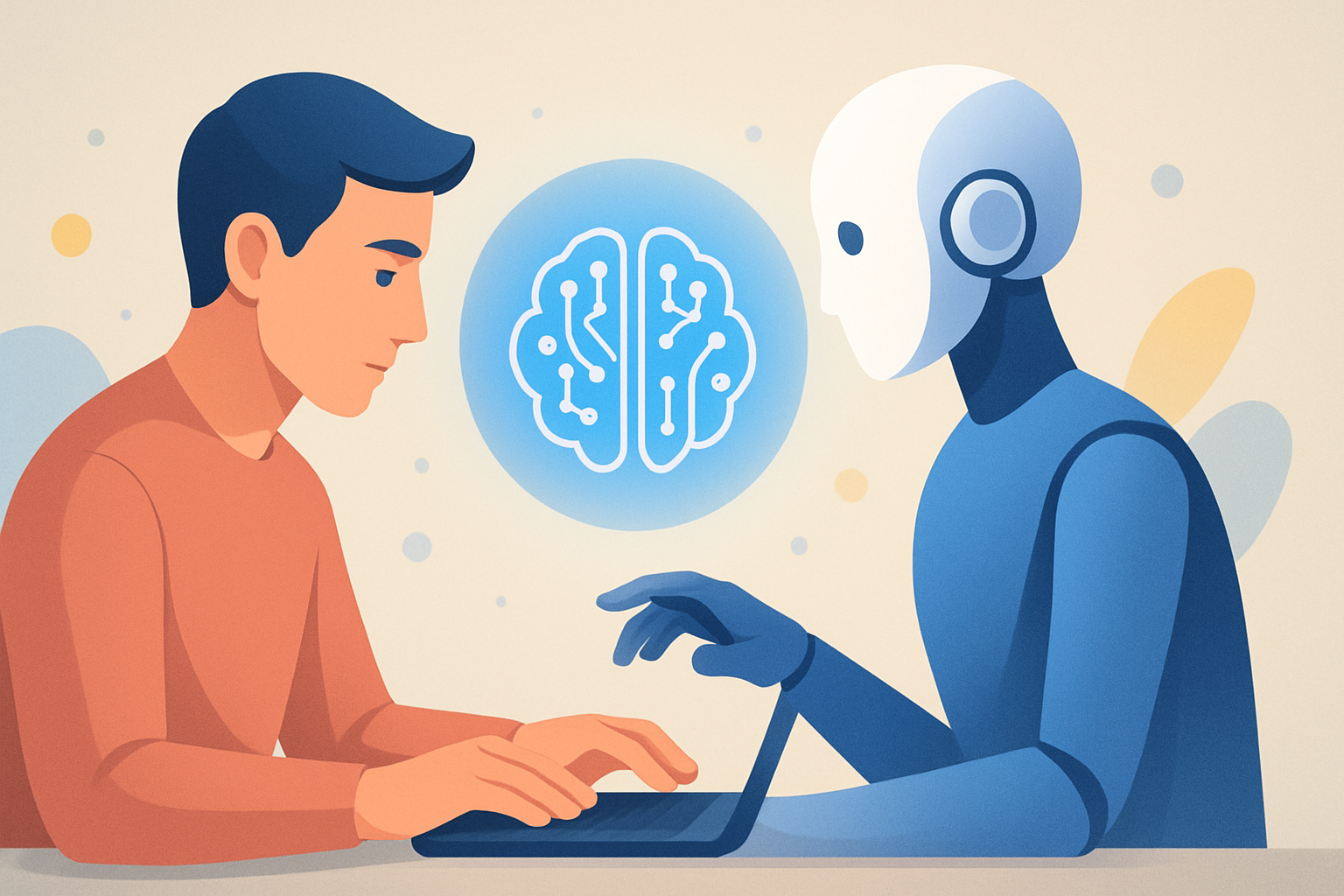
Ultimately, the best collaboration systems will feel less like tool usage and more like teamwork. Humans will set goals and validate outcomes. AI will handle the heavy lifting across steps, with auditable guardrails.
As 2026 approaches, the teams that win will treat collaboration as a design discipline. They will build workflows that are measurable, safe, and deeply integrated with real processes.