How AI Is Revolutionizing Manufacturing
Manufacturing has always relied on precision. However, modern factories now generate massive streams of data. That shift is enabling artificial intelligence to drive faster decisions and better outcomes. As a result, AI is reshaping everything from maintenance schedules to production planning.
In this article, we’ll look at how AI is revolutionizing manufacturing. We’ll also cover where it delivers value and what leaders should watch. Finally, we’ll address whether beginners can realistically adopt AI in industrial settings.
What is AI in manufacturing?
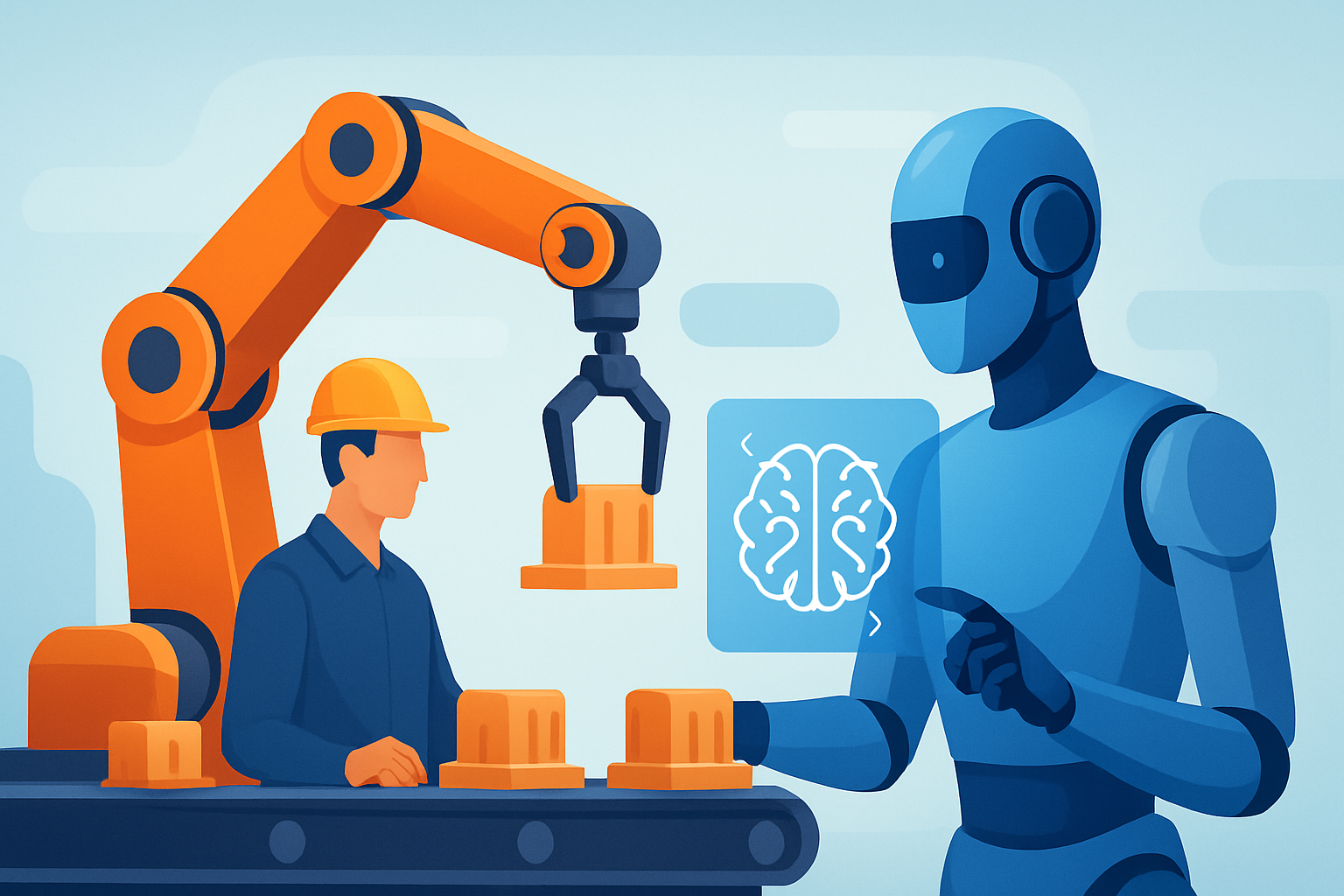
AI in manufacturing refers to using machine learning, computer vision, and optimization algorithms in factory workflows. These systems analyze sensor data, images, and operational signals. Then they help improve throughput, quality, safety, and cost control. Importantly, AI does not replace engineers and operators. Instead, it enhances their decision-making with faster insights.
Unlike traditional automation, many AI systems learn patterns from historical data. Therefore, they can adapt as conditions change. For example, an AI model may detect subtle variations in material behavior over time. It can also recognize recurring equipment issues before they become failures.
Common AI use cases in factories include predictive maintenance, anomaly detection, and computer vision-based quality inspection. Additionally, AI supports demand forecasting and inventory optimization. When these capabilities work together, factories become more responsive and resilient.
How does AI work in manufacturing?
AI in manufacturing typically follows a structured pipeline. First, data is collected from machines and processes. Next, that data is cleaned and organized for analysis. Then, models are trained to recognize patterns or predict outcomes.
After training, AI is deployed into production systems. It can provide real-time alerts or recommendations. Moreover, it can run in the background to continuously improve results. Finally, teams monitor performance and retrain models when needed.
Several technical approaches power these systems. Here are the most common ones:
- Machine learning for prediction: Models forecast failures, cycle time changes, or scrap risk.
- Computer vision for inspection: Cameras and AI detect defects on products and surfaces.
- Natural language processing for operations: AI can summarize maintenance logs and work orders.
- Optimization algorithms for planning: Systems schedule machines and inventory based on constraints.
- Digital twins: Simulations predict outcomes by modeling equipment and processes.
To illustrate, consider predictive maintenance. Sensors measure vibration, temperature, and motor current. An AI model learns how these signals look before specific failure modes. Then it triggers maintenance before breakdowns occur. Consequently, downtime and emergency repairs decrease.
Similarly, quality inspection uses computer vision. A camera captures images as parts move along a line. The AI compares each image to a learned standard. If defects appear, it flags the unit for review. As a result, defects are caught earlier and less product reaches customers.
Why is AI important for manufacturers right now?
Manufacturers face pressure from multiple directions. Customer expectations for speed and customization keep rising. At the same time, labor shortages and supply volatility complicate planning. Furthermore, energy costs and regulatory requirements demand better efficiency and traceability.
AI helps address these challenges by making production systems more data-driven. Instead of relying only on manual checks, teams can detect issues sooner. Additionally, AI can reduce waste by preventing errors before they scale.
Here are key reasons AI is gaining momentum in manufacturing:
- Reduced downtime: Predictive insights help schedule repairs proactively.
- Higher product quality: Computer vision improves consistency at scale.
- Lower operational costs: Better forecasting optimizes staffing and energy usage.
- Improved safety: Anomaly detection can identify unsafe operating conditions.
- More agile supply chains: Forecasting supports procurement decisions and inventory levels.
Another major factor is the rise of industrial data availability. Many factories now connect equipment through sensors and industrial networks. That creates a foundation for analytics and machine learning. Then cloud and edge computing make it practical to process data quickly. Consequently, AI can influence decisions near real time.
Still, success depends on execution. Teams must ensure data quality and define measurable objectives. When leaders treat AI as an operational improvement program, results tend to be more durable.
Is AI in manufacturing better than traditional automation?
Traditional automation excels at repeatable tasks. It uses rules, fixed logic, and mechanical controls. In many lines, that approach remains essential. For instance, robotics for pick-and-place actions can still outperform AI-based control. Therefore, AI should not be viewed as a universal replacement.
Instead, the comparison is about where intelligence adds the most value. AI shines when conditions are variable. It also helps when defect patterns are subtle or when equipment behavior changes over time. In these situations, rule-based systems struggle to keep up without constant reprogramming.
Here’s how AI often complements traditional automation:
- Detection vs. execution: Automation performs tasks; AI helps detect problems and optimize execution.
- Static rules vs. learning: AI learns from new data instead of relying solely on prewritten logic.
- Reactive troubleshooting vs. proactive prediction: AI can forecast issues before they cause downtime.
- Limited visibility vs. system-wide insights: AI can correlate data across equipment and stages.
Moreover, AI can help modernize legacy environments. Instead of replacing entire lines, factories can add AI layers for inspection and monitoring. Then they can gradually expand the footprint. This incremental approach reduces risk and makes adoption more cost-effective.
For additional context on broader industry transformation, see How AI Is Disrupting Traditional Industries. That piece explores how automation and analytics are reshaping other sectors too.
Can beginners use AI in manufacturing?
Many people assume AI deployment requires advanced engineering. However, beginners can start with practical steps. The key is selecting use cases with available data and clear business goals. Then teams can use tools that lower the barrier to entry.
For example, beginners can begin with computer vision for inspection. If a factory already has images and labels, a pilot can be feasible. Likewise, anomaly detection can start with historical time-series signals. Even if results aren’t perfect, early pilots can reveal patterns and guide improvements.
Still, real-world manufacturing introduces constraints. Data labeling can be expensive. Sensor data may be incomplete or inconsistent. Additionally, production teams must align on how alerts will be handled. Therefore, beginners should treat AI adoption as a collaboration across operations, quality, and IT.
To get started responsibly, follow these beginner-friendly steps:
- Choose one high-impact workflow: Start with quality checks or maintenance.
- Define success metrics: Track scrap reduction, uptime gains, or defect detection accuracy.
- Assess data readiness: Confirm sensor coverage, image quality, and labeling availability.
- Run a limited pilot: Test in one line or one shift to learn quickly.
- Plan for human-in-the-loop review: Ensure technicians can verify AI recommendations.
- Scale only after validation: Expand once you confirm measurable outcomes.
Also, consider partnering with vendors or integrators. They can help connect data sources to analytics pipelines. However, beginners should still understand the fundamentals. Knowing what the model predicts, where data comes from, and how to evaluate results matters.
For entrepreneurs exploring AI adoption broadly, you may find Free AI Tools for Entrepreneurs helpful. While not manufacturing-specific, it offers a starting point for experimenting with AI workflows.
Where AI is delivering value across the factory
AI impacts manufacturing in multiple layers. It can improve the shop floor and also strengthen the planning side. As factories evolve toward smart operations, these layers increasingly connect through data.
Below are major areas where AI commonly delivers measurable benefits:
- Predictive maintenance: Forecast failures using sensor patterns and historical events.
- Quality assurance: Use AI vision to identify defects and measure dimensions.
- Process optimization: Recommend parameter changes for yield, speed, and energy efficiency.
- Production scheduling: Improve sequencing by optimizing constraints and resource availability.
- Inventory and demand planning: Predict demand signals to reduce stockouts and overstock.
- Safety and compliance: Detect unsafe conditions and support audit-ready reporting.
Notably, these improvements compound. For example, better quality reduces rework. Reduced rework improves throughput. Better throughput then makes scheduling more accurate. In this way, AI can create a positive feedback loop across operations.
Supply chain planning also benefits. AI can forecast component demand and align procurement timelines. When production relies on just-in-time inventory, small forecasting errors become costly. Therefore, more accurate predictions can directly impact costs and customer delivery performance.
The future of AI in manufacturing: what to watch
AI adoption is accelerating, yet the next wave will emphasize reliability and integration. Many organizations already have pilot projects running. However, scaling them requires stronger governance, better data pipelines, and clearer accountability.
Several trends are likely to shape the near future:
- Edge AI deployment: Models will run closer to machines for lower latency.
- Federated learning: Factories may train models across sites without sharing raw data.
- More robust quality systems: AI inspection will integrate with traceability and reporting.
- Digital twins at scale: Simulations will guide planning and maintenance strategies.
- Governance and explainability: Teams will demand clearer decision logic for compliance.
Another important factor is integration with existing systems. Manufacturers rely on ERP, MES, CMMS, and industrial controls. Therefore, AI initiatives must fit into those workflows. If AI outputs do not reach operators effectively, value will be limited. Successful deployments connect insights to action through alerts, dashboards, and recommended next steps.
For readers interested in adjacent optimization workflows, consider AI Tools for E-commerce Optimization. The underlying concepts of forecasting and optimization translate well across industries.
Key Takeaways
AI is revolutionizing manufacturing by improving prediction, inspection, and planning. It helps factories reduce downtime, lower defects, and respond faster to changing demand. Importantly, AI works best when it complements automation instead of replacing it.
To gain value, manufacturers should start with clear use cases and measurable goals. They should invest in data readiness and plan for human review during early deployments. Finally, scaling requires integration, governance, and ongoing monitoring.
As AI becomes more embedded in industrial workflows, manufacturing will keep evolving. Those who adopt strategically will likely build stronger, more efficient production systems for the future.