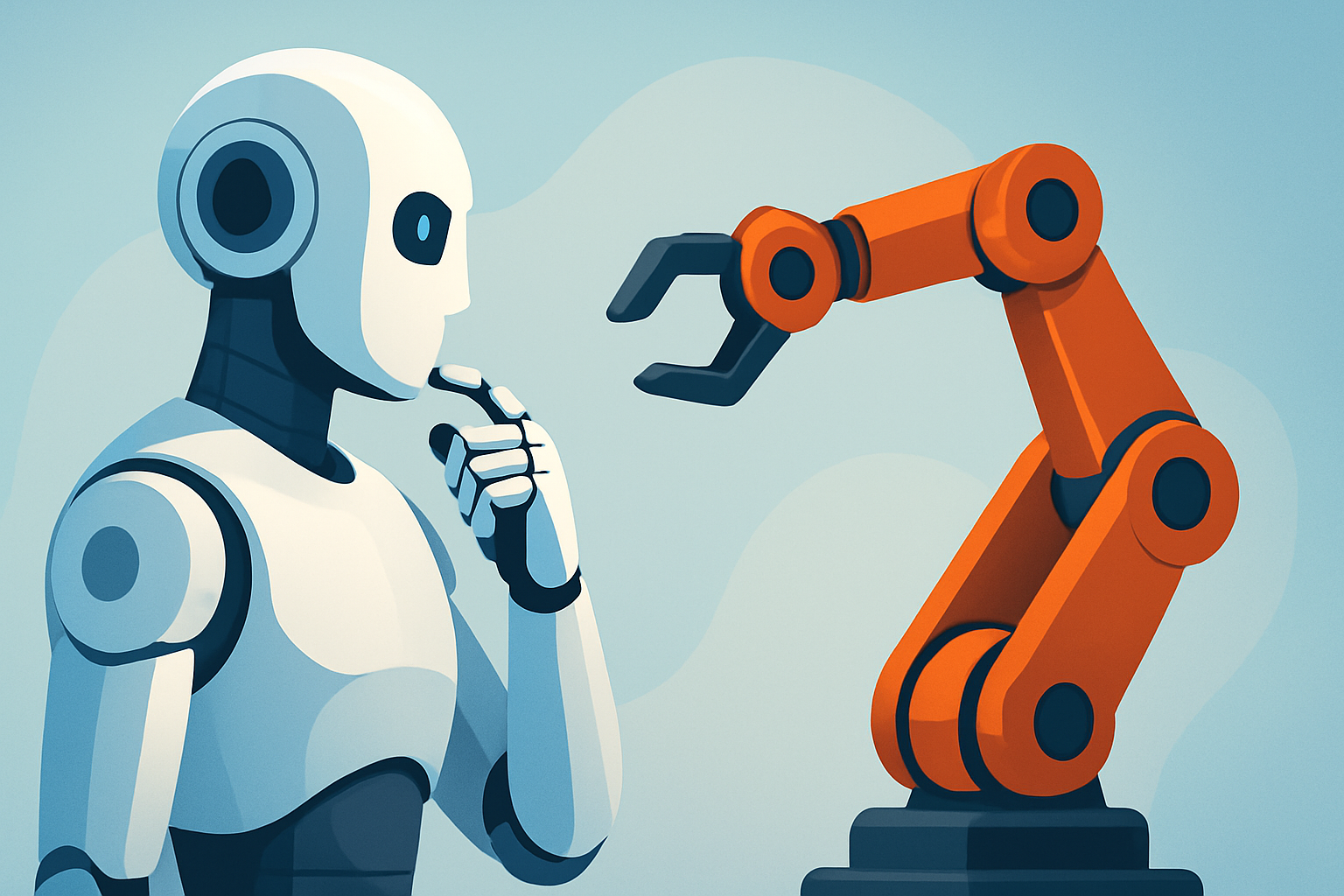
AI Trends in Robotics You Should Watch
AI is reshaping robotics faster than ever, with better perception, smarter planning, safer autonomy, and faster training through simulation.
Quick Overview
- Foundation models are moving from text into robots’ vision and control.
- Multimodal AI improves how robots understand environments and tasks.
- Simulation and “synthetic data” accelerate training for real-world deployment.
- Safety, verification, and regulation are becoming core engineering requirements.
Why AI Trends in Robotics Are Accelerating Now
Robotics has always relied on heavy engineering and careful tuning. However, recent AI progress is changing the balance between handcrafted rules and learned behavior. As models improve, robots can generalize across new scenes and tasks.
At the same time, costs are falling. Better sensors, cheaper compute, and improved tooling reduce the barrier to building robotic systems. Consequently, more companies are experimenting with autonomy, in warehouses, factories, hospitals, and homes.
Even so, the biggest shift is conceptual. Robotics teams are increasingly treating robots like intelligent agents. They combine perception, planning, and action under a unified AI stack.
Below are key AI trends in robotics that you should watch. Each trend matters because it changes what robots can do reliably, and how quickly developers can ship improvements.
Foundation Models Move Into Robot Brains
Foundation models began in language and vision. Now, they are expanding into robotics. The goal is simple: give robots richer “understanding” of the world.
Instead of training separate models for every task, foundation-inspired approaches aim to reuse learned representations. For example, a robot that learns robust visual features can adapt faster to new manipulation jobs. Likewise, models that understand human instructions can translate them into actions.
However, robotics adds complexity. Robots operate in continuous space and time. Therefore, foundation models must connect to control policies and safety constraints.
What to watch
- Robot-friendly foundation models for vision, language, and embodied decision making
- Multistage architectures that separate “understanding” from “control”
- Benchmarks that measure real task performance, not just simulation scores
Multimodal AI for Better Perception and Human Interaction
Another major trend is multimodal learning. Robots increasingly combine information from multiple sources. Those sources can include RGB cameras, depth sensors, tactile signals, audio, and text instructions.
Multimodal systems can interpret ambiguous situations more effectively. For instance, vision might miss a key detail. Yet depth and tactile feedback can confirm contact. Meanwhile, audio cues can clarify what a human intends.
As a result, robots become more usable in real spaces. They can respond to natural requests and adapt to partial information.
If you’re also tracking practical AI tools for building prototypes, explore how to build your first AI chatbot. It offers a helpful mindset for combining models, interfaces, and workflow design.
End-to-End Learning Meets Modular Safety Systems
End-to-end learning promises faster development. It aims to connect perception directly to actions. Yet robotics requires dependable behavior under uncertainty.
That tension is producing a hybrid pattern. Teams use learned models for flexible behavior. Meanwhile, they enforce safety with modular layers. Those layers can include collision avoidance, constraint checks, and formal verification mechanisms.
Consequently, the field is moving toward “AI with guardrails.” The robot learns broadly, but acts within strict limits.
Common safety-focused components
- Real-time safety monitors that supervise commands
- Redundant sensing for obstacle detection
- Constrained motion planning to prevent unsafe trajectories
- Policy fallback modes when uncertainty rises
Simulation-First Development and Synthetic Data
Training robots in the real world is expensive. It risks wear-and-tear, downtime, and safety incidents. Therefore, developers increasingly rely on simulation.
However, simulation alone is not enough. The robot must generalize to real lighting, textures, friction, and camera angles. To bridge this gap, teams use domain randomization and synthetic data generation.
Over time, simulation becomes more realistic. Additionally, feedback loops can incorporate real sensor data back into models. This approach shortens iteration cycles.
In parallel, researchers are pushing for “sim-to-real” methods that reduce the need for manual calibration. That trend matters because it speeds up deployment across new sites.
You can also connect this idea to broader AI experimentation. If you want practical background on building data workflows, see how to use AI for data analysis.
Robot Learning from Demonstrations and Video
Robots can learn from data faster than from scratch. That’s why learning from demonstrations is growing. Instead of writing a new program for each task, developers can record human or expert behavior.
Then models learn how to translate those examples into robot actions. Video-based learning is a natural extension. It allows robots to observe tasks from multiple angles and interpret progress cues.
Yet a key challenge remains. Robots must transform observed actions into physically valid motion. They also need to handle variations in objects and environments.
Therefore, expect more work on action representations. Examples include keypoints, affordances, and trajectory encodings that remain stable under changes.
Vision-Language-Action (VLA) Systems
Vision-language-action systems combine image understanding, textual intent, and motor skills. In practice, they can accept instructions like “pick up the red mug” or “scan that label.”
As those systems mature, robotics interactions become simpler. Developers can describe tasks at a higher level. Then the model generates intermediate steps for execution.
However, the real-world challenge is grounded reasoning. A robot must confirm object identity, handle occlusions, and ensure the target is reachable. Thus, VLA systems increasingly integrate with perception modules and grasp planners.
Where VLA is most useful
- Warehouse picking and sorting with flexible item layouts
- Lab automation where tasks are specified by researchers
- Field robotics where objects differ by location
- Assistive robotics that responds to personal instructions
Humanoids and Bipedal AI: Progress with Practical Limits
Humanoid robots attract attention because they match human environments. That includes stairs, tools, and workflows designed for people. As a result, humanoids can theoretically transfer skills quickly.
Still, bipedal locomotion is hard. Balance, friction changes, and impact forces can destabilize systems. Therefore, progress often depends on better control and better data.
In the near term, many humanoid systems focus on constrained tasks. Those tasks can include standing, simple navigation, or limited manipulation. Over time, learning-based controllers may reduce the need for handcrafted balance rules.
Watch for improvements in leg control, recovery from falls, and safe human-robot interaction. Those elements will determine whether humanoids move beyond demos.
Robots as Teams: Multi-Agent Coordination
Single robots can be useful, but teams scale better. Multi-agent robotics uses AI to coordinate multiple units. That coordination can include task allocation, shared mapping, and collision management.
Additionally, multi-robot systems can distribute risk. If one unit fails, others can compensate. They can also increase throughput in warehouses and logistics centers.
Key enablers include shared perception pipelines and communication protocols. Furthermore, robust planning algorithms reduce deadlocks and inefficient motion.
Expect more research on decentralized coordination. Those methods reduce single points of failure and improve reliability.
Edge AI and On-Device Autonomy
Cloud-based robotics is useful for training and monitoring. Yet real-time control often requires local decisions. Latency can break safety-critical actions.
Therefore, edge AI is becoming a core trend. Models run closer to sensors, reducing delays and network dependency. This also improves privacy for home and healthcare settings.
However, running advanced models on hardware is not trivial. Robotics requires tight power budgets and predictable compute. Consequently, model compression and hardware-aware optimization are growing topics.
What to look for in edge deployments
- Smaller, faster models that maintain task accuracy
- Hardware accelerators built into robot platforms
- Streaming sensor pipelines designed for low latency
- Clear fallback behavior when connectivity is lost
Regulation, Benchmarking, and Safety Verification
As robotics becomes more autonomous, governance becomes more important. Companies need to prove safety, not just performance. That includes risk assessments and operational constraints.
Meanwhile, benchmarking is evolving. Early metrics often focused on isolated demos. New benchmarks aim to test long-horizon reliability, error recovery, and real-time constraints.
Expect more formal safety verification methods too. Some teams use runtime monitoring, while others use offline verification for known scenarios.
For buyers and developers, this shift is significant. It changes procurement and engineering workflows. It also influences how robots are evaluated in hospitals, factories, and public spaces.
If you’re comparing AI approaches and want decision frameworks, consider AI Tools Comparison: Which One Is Best?. It supports a practical evaluation mindset that maps well to robotics selection.
How It Works / Steps
- Sense the environment: cameras, depth, IMUs, and sometimes tactile sensors capture state.
- Understand inputs: AI models interpret objects, obstacles, and human intent.
- Plan actions: planners generate safe trajectories or sequences of steps.
- Control the robot: motion controllers execute actions with feedback loops.
- Check safety constraints: monitors prevent collisions and handle uncertainty.
- Learn and improve: results feed back into training pipelines and policies.
Examples
Smart warehouses: Robots identify packages using vision-language cues. Then they pick, verify, and sort. Multi-robot coordination improves throughput.
Retail and hospitality: Service robots navigate crowded floors. Multimodal perception helps avoid obstacles and people. Natural language interfaces reduce training requirements.
Healthcare and labs: Robots move reagents or samples with higher precision. Video learning and simulation speed up setup for new protocols. Safety layers prevent harmful interactions.
Field robotics: Robots interpret instructions for inspection tasks. Domain adaptation supports varied lighting and terrain. Edge autonomy reduces dependency on connectivity.
FAQs
Which AI trend in robotics matters most for the next year?
Multimodal and VLA-style systems are likely to deliver visible improvements. They make robots easier to control using language and richer perception. Safety guardrails will also be a major differentiator.
Will robots become fully autonomous soon?
Fully general autonomy is unlikely in the near term. However, robots will gain autonomy in constrained environments. Expect strong progress in error recovery and long-horizon reliability.
Why is simulation so important for robotics?
Simulation reduces cost and risk during training. It also accelerates iteration by allowing rapid scenario generation. The challenge is achieving sim-to-real generalization.
Do foundation models replace classical robotics software?
Not entirely. Classical planning and control remain important for dependable motion. Foundation models often enhance perception and decision making, while safety systems enforce constraints.
How can developers evaluate robotics AI vendors?
Look for real-world performance metrics, recovery behavior, and clear safety documentation. Also assess integration effort, compute requirements, and deployment timelines. Benchmarks that reflect your environment are especially useful.
Key Takeaways
- Foundation models and multimodal AI are changing how robots understand tasks.
- Hybrid architectures pair learned policies with strict safety systems.
- Simulation-driven training is accelerating real-world deployments.
- Edge autonomy, better benchmarking, and verification are becoming essential.
Conclusion
AI trends in robotics are moving beyond novelty. They are turning autonomous behavior into something closer to dependable engineering. Foundation models, multimodal perception, and simulation-driven learning all contribute to that shift.
Meanwhile, safety and verification are rising to match the pace of AI capability. Teams that treat safety as a first-class feature will likely lead deployments. Finally, multi-robot coordination and edge AI expand where autonomy can work reliably.
If you’re tracking where robotics is headed, focus on systems that combine strong learning with practical constraints. That combination is what will separate impressive demos from tools that genuinely help people and businesses every day.