How AI Is Transforming Customer Service
AI-driven tools are rapidly changing how businesses serve customers. From chatbots to predictive analytics, artificial intelligence reshapes interactions and operations. This article explains the technologies, benefits, and practical steps companies take. It also explores implications for business leaders and customer experience teams.
Why AI Matters for Customer Service Today
Customer expectations keep rising, while budgets stay tight. Companies need scalable solutions that improve responsiveness and personalize service. Artificial intelligence offers automation without sacrificing empathy. As a result, teams can handle more requests and focus on complex problems.
Furthermore, AI enables new service models across channels. Customers now expect fast self-service, accurate answers, and seamless escalation. Businesses that adopt AI tools often see higher satisfaction and lower costs.
Key AI Technologies Powering Customer Service
A variety of AI systems drive modern customer service. Each solves specific pain points like volume, consistency, and personalization. Below are the most impactful technologies being deployed.
Chatbots and Conversational AI
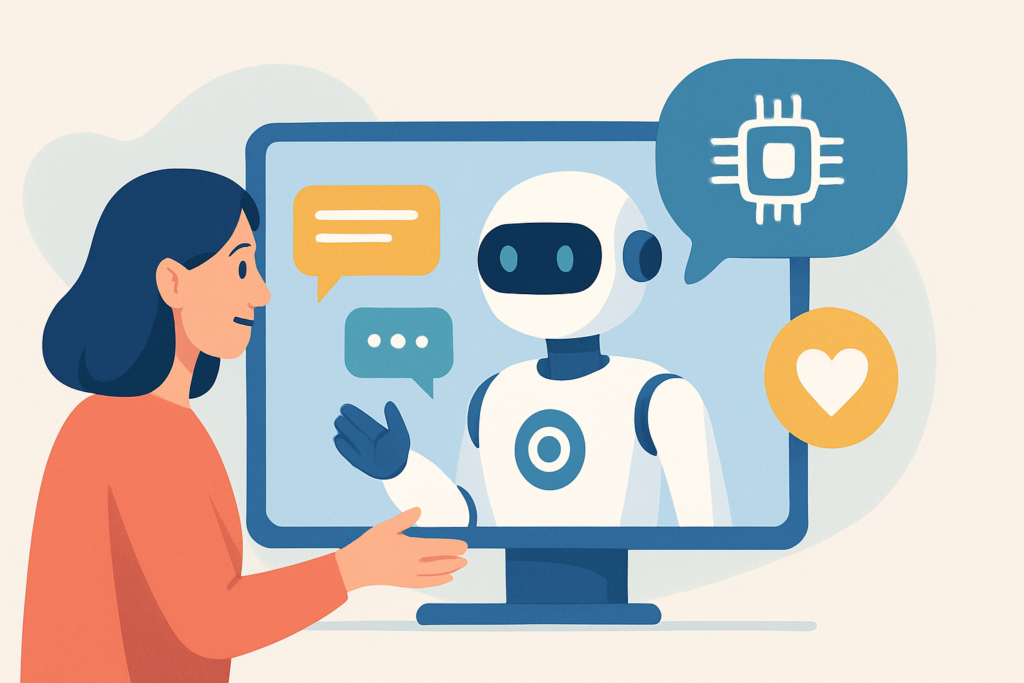
Chatbots handle routine inquiries across chat, web, and messaging apps. Natural language processing allows bots to understand user intent. They can route complex issues to human agents with context preserved. For teams building a bot from scratch, resources like How to Build Your First AI Chatbot provide practical guidance.
Virtual Assistants and Voice AI
Voice assistants extend self-service to phone and smart devices. Speech recognition and intent classification reduce hold times. These systems also feed analytics that identify common friction points.
Predictive Analytics and Recommendation Engines
Predictive models forecast churn, sentiment, and product needs. They drive proactive outreach, targeted offers, and better resource allocation. Using predictions, teams can reduce escalations and improve retention.
Knowledge Management and Search
AI-powered search finds answers faster for both customers and agents. Semantic search and automated knowledge base updates keep answers accurate. They also reduce duplicated effort and training time.
Sentiment Analysis and Emotion Detection
Sentiment analysis scores customer tone in real time. This helps prioritize urgent cases and adjust agent responses. Emotion-aware routing can elevate sensitive issues to senior staff.
Business Benefits: Efficiency, Personalization, and Cost Control
AI brings measurable gains across service teams. These include faster resolution, greater consistency, and lower handling costs. Leaders should view AI as an amplifier of human work, not a simple replacement.
Key benefits include improved first-contact resolution and reduced average handle time. AI also supports 24/7 availability without continuous staffing. These gains help businesses scale without proportional cost increases.
- Higher customer satisfaction due to faster, more accurate responses.
- Reduced operational costs through automation and optimization.
- Greater agent productivity via intelligent assistance and routing.
- Data-driven personalization that increases loyalty and revenue.
How AI Changes the Customer Journey
AI intervenes at each stage of the customer lifecycle. It can improve discovery, onboarding, support, and retention. For example, personalized product suggestions can prevent support requests before they begin.
Meanwhile, agents receive AI-suggested replies and knowledge articles in real time. This reduces training time and improves response quality. Companies that align AI with journey maps see faster impact.
Proactive Support and Issue Prevention
Predictive systems notify customers before problems occur. For instance, they can warn users of service outages or account issues. Proactive outreach reduces frustration and builds trust.
Seamless Omnichannel Experience
AI unifies conversations across channels. Customers can switch from chat to phone without repeating information. Context preservation improves satisfaction and lowers repeats.
Implementation Challenges and Ethical Considerations
Implementing AI is not without challenges. Data quality, integration complexity, and change management often slow adoption. Leaders must prepare for these obstacles during planning.
Ethical considerations also deserve attention. Privacy, bias, and transparency affect trust and compliance. Companies should design AI with fairness and clear human oversight.
- Data governance and privacy need well-defined policies and controls.
- Bias mitigation requires diverse training data and regular audits.
- Clear escalation paths ensure humans handle sensitive cases.
- Transparent communication helps customers understand automated decisions.
Best Practices for Deploying AI in Customer Service
Successful AI projects start with clear objectives and measurable metrics. Define the problems you want AI to fix and set KPIs. For example, track response time, resolution rate, and customer satisfaction.
Begin with high-impact, low-risk use cases like FAQ automation. Iterate based on user feedback and performance data. Also, involve agents early to build trust and refine workflows.
- Start small with pilot projects and scale on success.
- Combine AI automation with human oversight for quality control.
- Use analytics to continuously tune models and content.
- Prioritize privacy and compliance in every deployment.
Real-World Examples: Business Use Cases
Companies across industries adopt AI to improve service. Retailers use chatbots for order tracking and returns. Financial firms apply predictive models to detect fraud and reduce disputes.
Smaller companies benefit too, by using cost-effective tools. See curated options and recommendations in Top AI Tools for Small Business Growth. These tools make adoption faster and more affordable.
Meanwhile, AI also supports cost reduction strategies. For an in-depth view, read How Businesses Are Using AI to Cut Costs in 2026. The article examines automation, optimization, and measurable savings.
Impact on Jobs and Workforce Skills
AI changes job roles rather than simply eliminating them. It automates routine tasks and elevates complex work. Agents increasingly focus on relationship building and problem solving.
Reskilling and upskilling are essential. Training should emphasize communication, judgment, and oversight skills. For a broader debate, see Is AI Replacing Jobs or Creating New Ones?
Emerging Trends and What Comes Next
Several trends will shape the next phase of AI in customer service. Multimodal AI will combine text, voice, and visual inputs for richer interactions. Large language models will continue improving contextual understanding.
Moreover, AI will increasingly power hyper-personalization. Systems will use transaction and behavioral signals to tailor experiences. As a result, businesses can deliver more relevant and timely support.
Key Takeaways
- AI optimizes customer service through automation and intelligence.
- Core technologies include chatbots, predictive analytics, and sentiment analysis.
- Benefits are faster support, lower costs, and more personalized experiences.
- Successful adoption requires data quality, ethics, and reskilling efforts.
- Start small, measure impact, and prioritize human oversight.
Conclusion
AI is transforming customer service across industries and company sizes. It enhances speed, personalization, and efficiency while preserving human judgment. Businesses that plan thoughtfully will gain a competitive advantage.
Leaders should focus on measurable use cases, ethical design, and workforce readiness. With these elements in place, AI can deliver better service and stronger customer relationships.